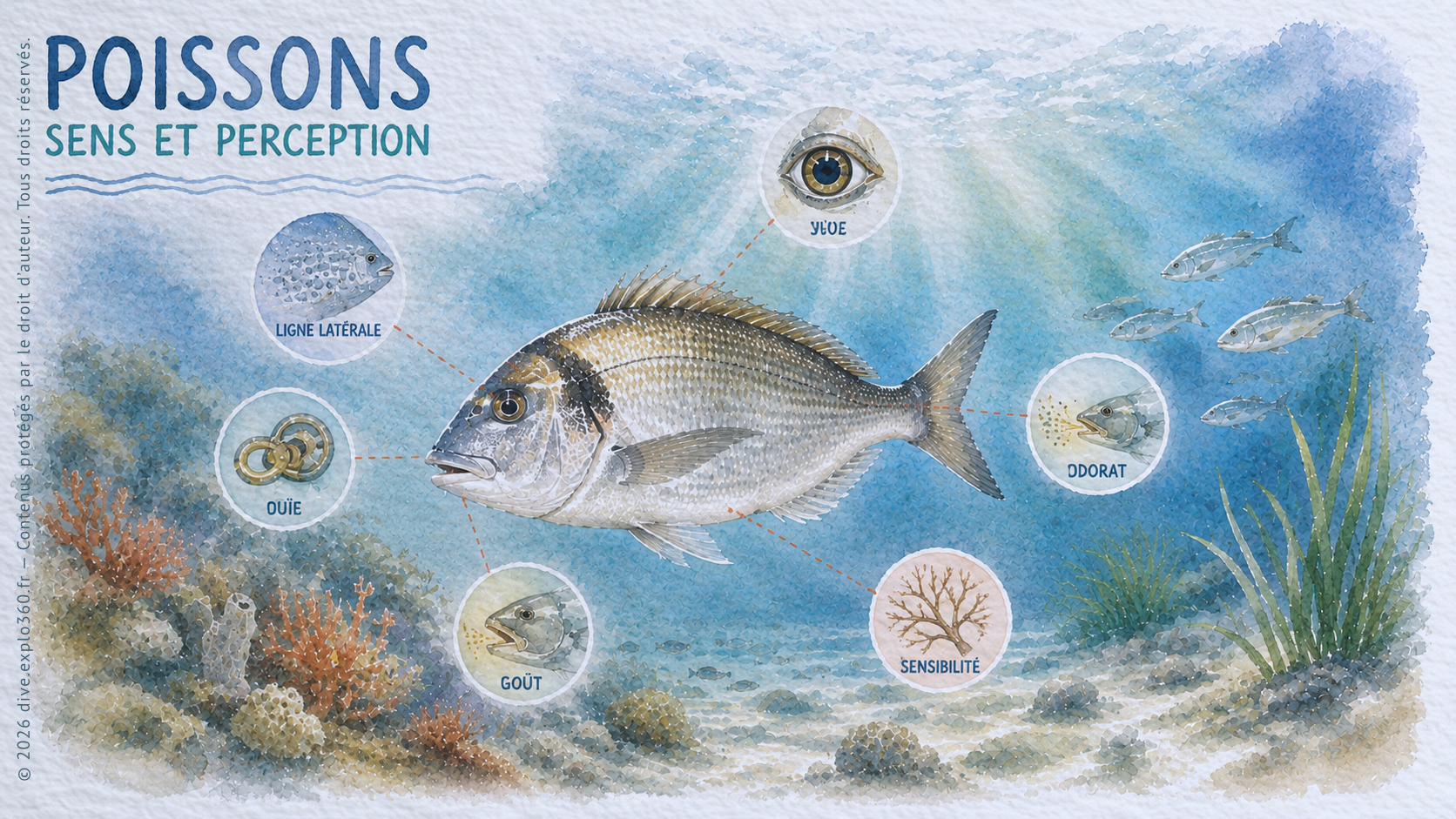
Inner ears for hearing

A fish has ears inside its head. In most bony fish, each inner ear holds three small structures called otoliths, made of calcium carbonate.

When the otoliths move against the tissues around them, sensory cells pick up the motion. The inner ear helps the fish hear and sense its position. In some species, the swim bladder also helps transmit sound to the ear.
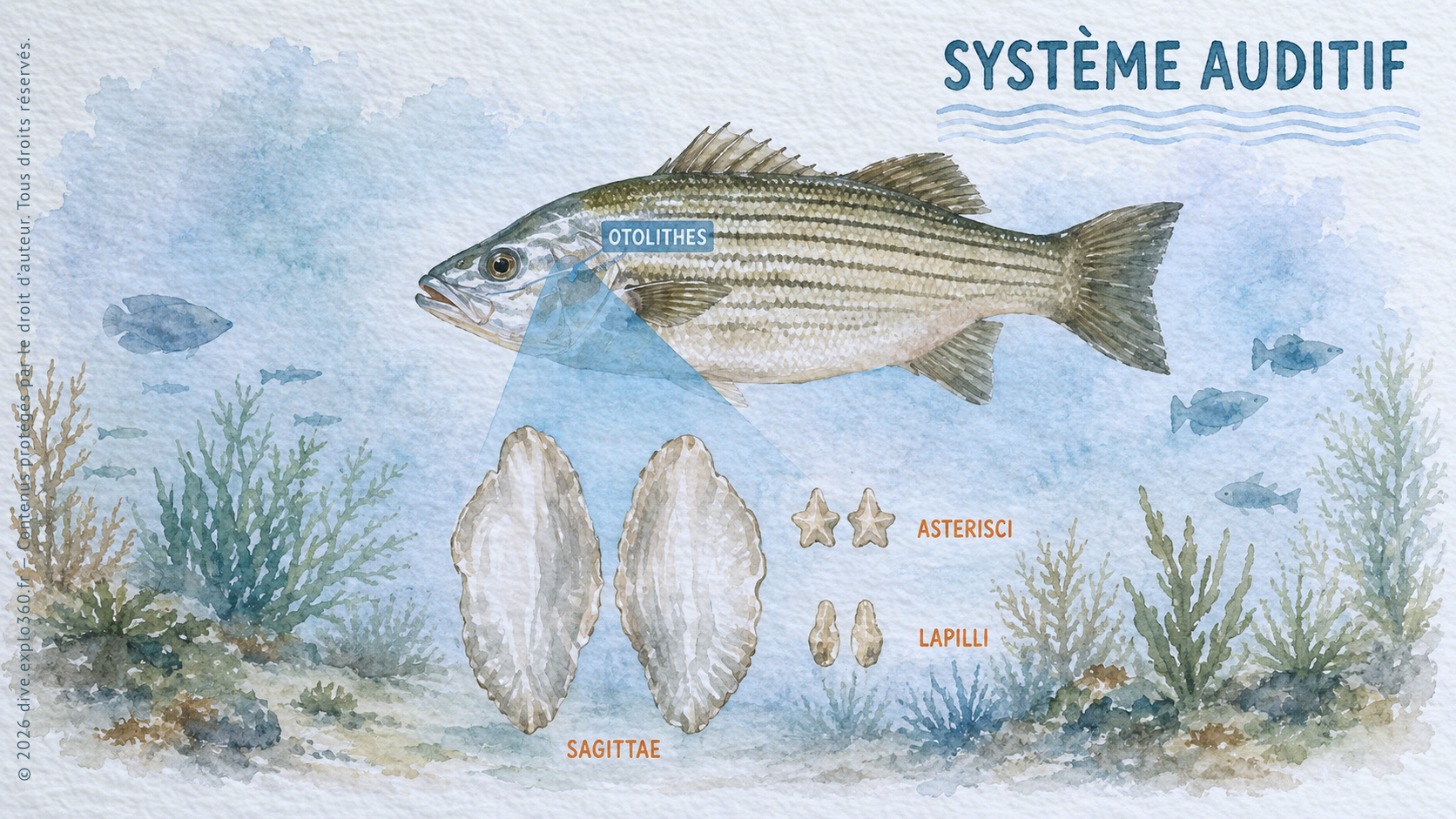
Schematic representation of a bony fish’s inner ear.
Fish hear using organs hidden inside their heads. In the inner ear of bony fish, otoliths help detect movement associated with sound. © dive.explo360.fr — All rights reserved. Reproduction requires permission.

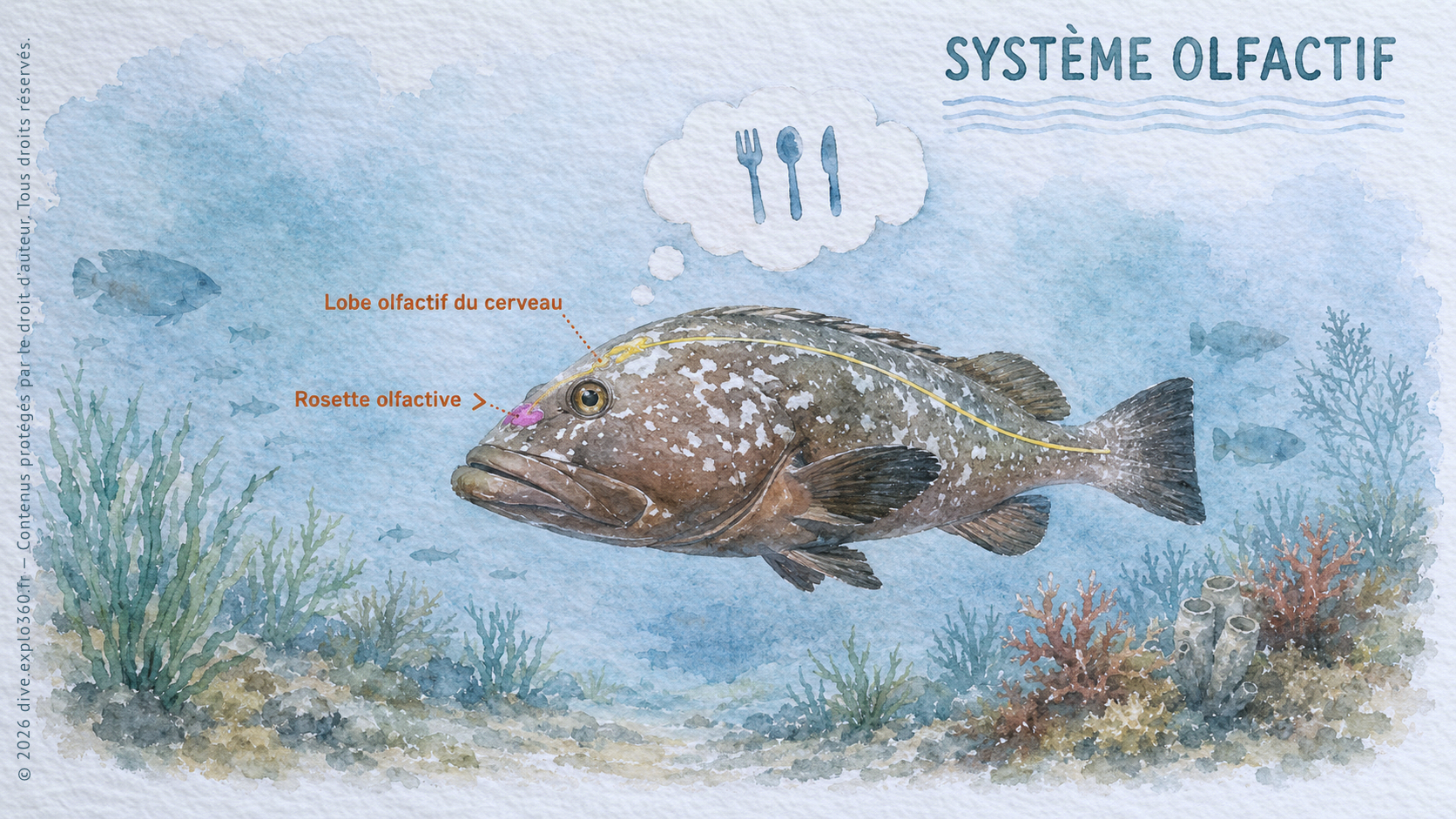
Smelling dissolved substances

Water carries dissolved substances to the olfactory organs.
Water carries smells to the fish’s nose. Dissolved molecules reach the olfactory organs. Currents alter how those cues travel. © dive.explo360.fr — All rights reserved. Reproduction requires permission.

Water enters small openings on the snout and carries dissolved molecules past cells that detect smells. The fish takes up oxygen through its gills.

A smell can give away food or another fish nearby. Some species also respond to chemicals released by an injured fish. Which signals they pick up varies among species.

GO FURTHER WITH AMIGANSEAU

Continue reading

Discover full species guides, in-depth content and interactive tools available with your licence.

Your subscription helps preserve our independence.

Dive.Explo360 is an independent, self-funded nonprofit. Every licence helps us create new content, improve our teaching tools and keep some of our resources free and ad-free.

Licences from €80 per year

Choose a licence that suits your needs for personal, educational or professional use.

Open-access resources remain available without a subscription.

Sources

1 - L’OUÏE Popper, A. N., & Fay, R. R. (2011). "Rethinking sound detection by fishes". *Hearing Research*, 273(1-2), 25-36.www.sciencedirect.comLadich, F., & Fay, R. R. (2013). "Auditory evoked potential audiometry in fish". *Reviews in Fish Biology and Fisheries*, 23(3), 317-364.link.springer.comBuscaino, G., Filiciotto, F., Buffa, G., Bellante, A., Stefano, V. D., Assenza, A., ... & Mazzola, S. (2010). "Impact of an acoustic stimulus on the motility and blood parameters of European sea bass "(Dicentrarchus labrax L.) and gilthead sea bream (Sparus aurata L.). *Marine Environmental Research*, 69(3), 136-142.www.raincoast.org2 - L’ODORAT Hara, T. J. (1994). "Olfaction and gustation in fish: an overview". *Acta Physiologica Scandinavica*, 152(S621), 1-13.pubmed.ncbi.nlm.nih.govDøving, K. B., & Stabell, O. B. (2003). "Trails in open waters: sensory cues in salmon migration". *Fish and Fisheries*, 4(3), 231-252.link.springer.comTierney, K. B., & Baldwin, D. H. (2011). "Olfactory toxicity in fishes". *Aquatic Toxicology*, 101(1), 1-13.pubmed.ncbi.nlm.nih.gov3 - LE GOÛT Kasumyan, A. O., & Døving, K. B. (2003). "Taste preferences in fishes". *Fish and Fisheries*, 4(4), 289-347.www.researchgate.net4 - LE TOUCHER Bleckmann, H. (2008). "Peripheral and central processing of lateral line information". *Journal of Comparative Physiology A*, 194(2), 145-158.pubmed.ncbi.nlm.nih.govCoombs, S., & Montgomery, J. (1999). "The enigmatic lateral line system". *Environmental Biology of Fishes*, 56(1-2), 1-2.link.springer.comMonroe et al. — Sensory hair cell death and regeneration in fishespmc.ncbi.nlm.nih.govPopper and Hawkins — An overview of fish bioacoustics and the impacts of anthropogenic sounds on fishespmc.ncbi.nlm.nih.gov