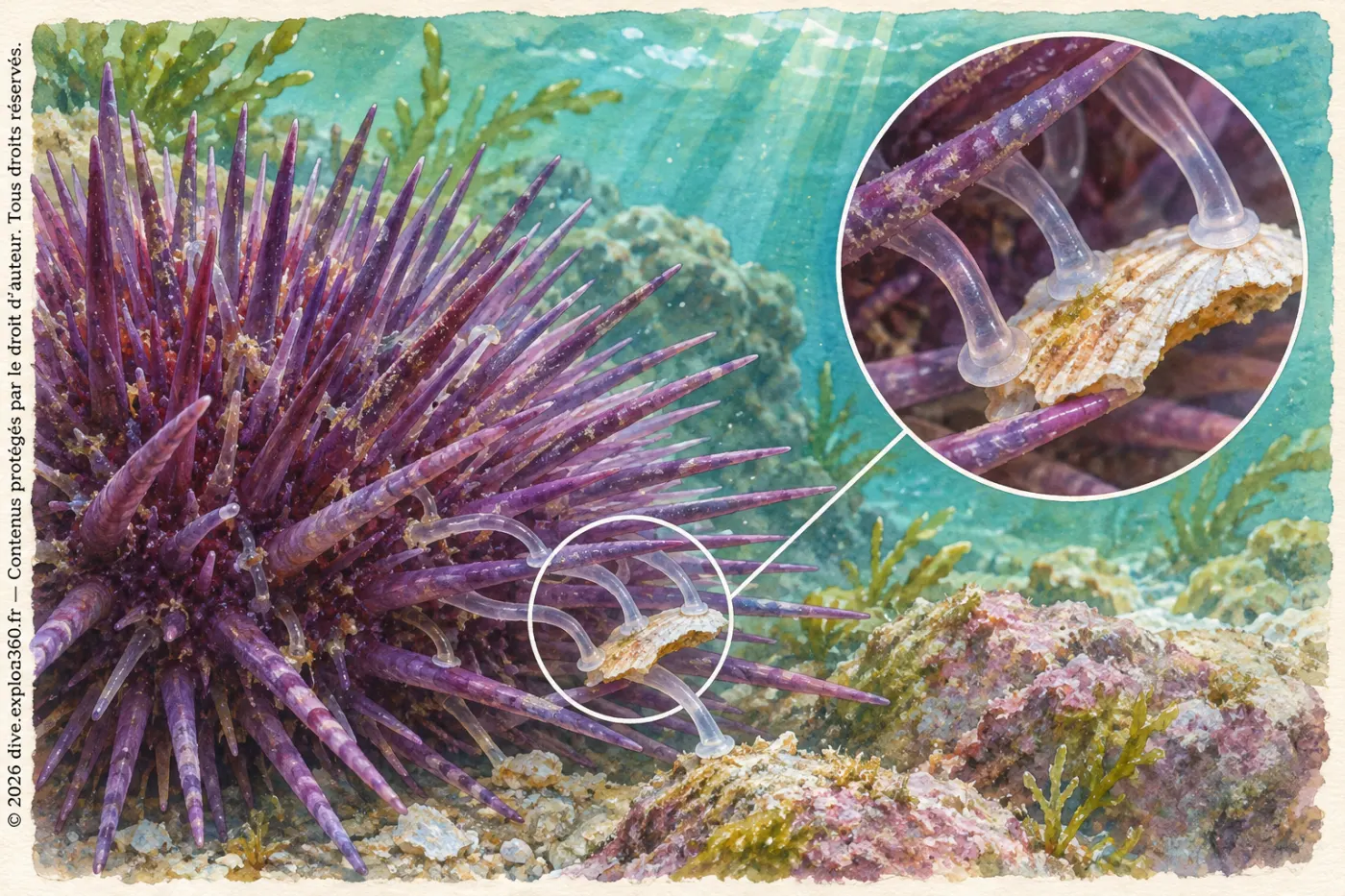
Tube feet pass a fragment with help from the spines. The enlarged inset simplifies the structures and uses a different scale.
Tube feet pass a fragment with help from the spines. The enlarged inset simplifies the structures and uses a different scale. © 2026 dive.explo360.fr — Contenus protégés par le droit d’auteur. Tous droits réservés.

Building a collection, one piece at a time

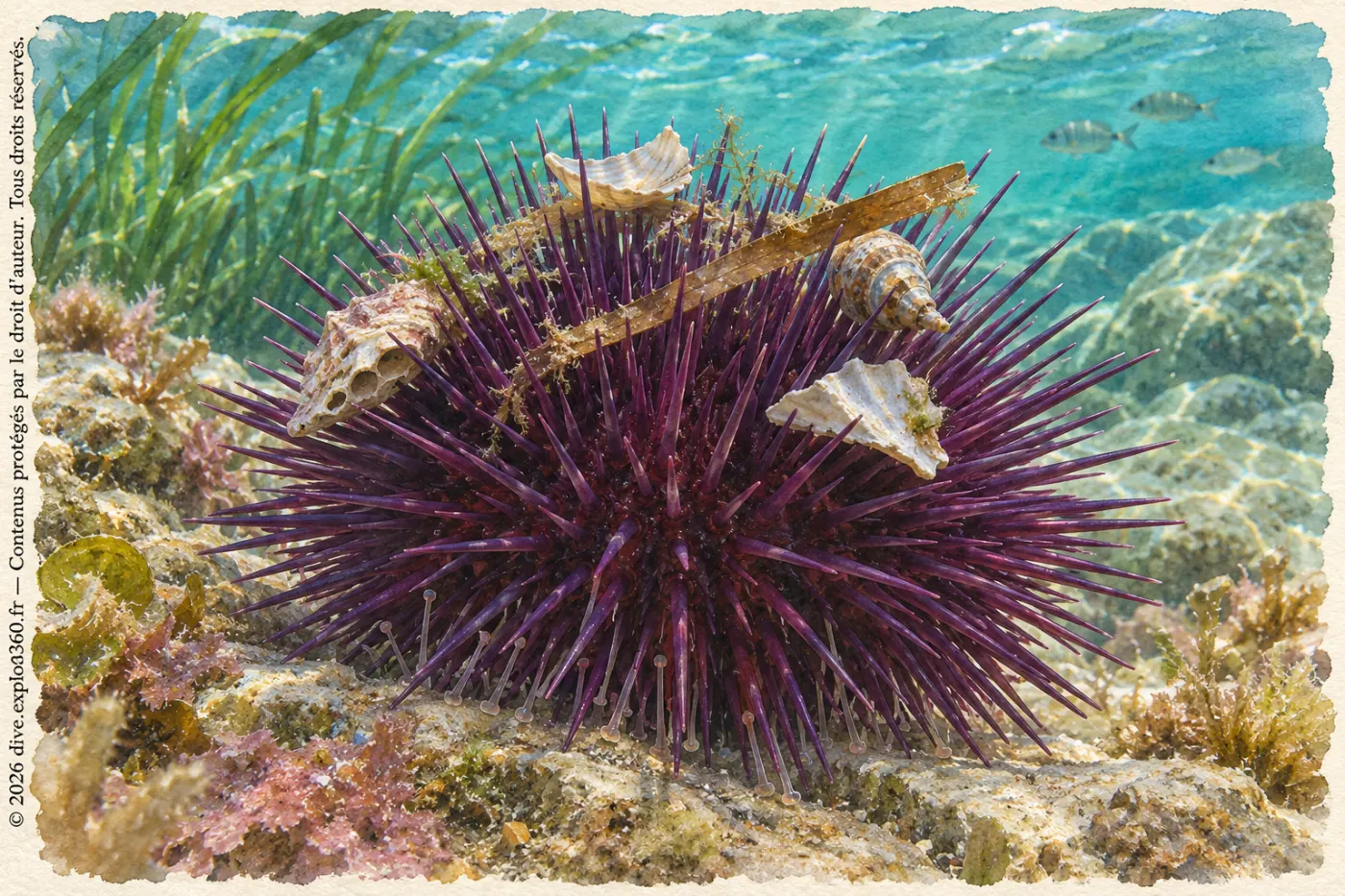
A purple sea urchin picks up shells and seaweed. Soft tube feet between its spines grip each piece and pass it upwards. The spines help. As the urchin moves, it holds its collection in place, dropping some pieces and adding others.

Shade from a shell

An urchin has no eyes like ours, but parts of its body sense light. Some species cover themselves more in bright conditions. Opaque shells block some sunlight, including ultraviolet rays. Covering also happens in dim light, so shade is not the whole story.
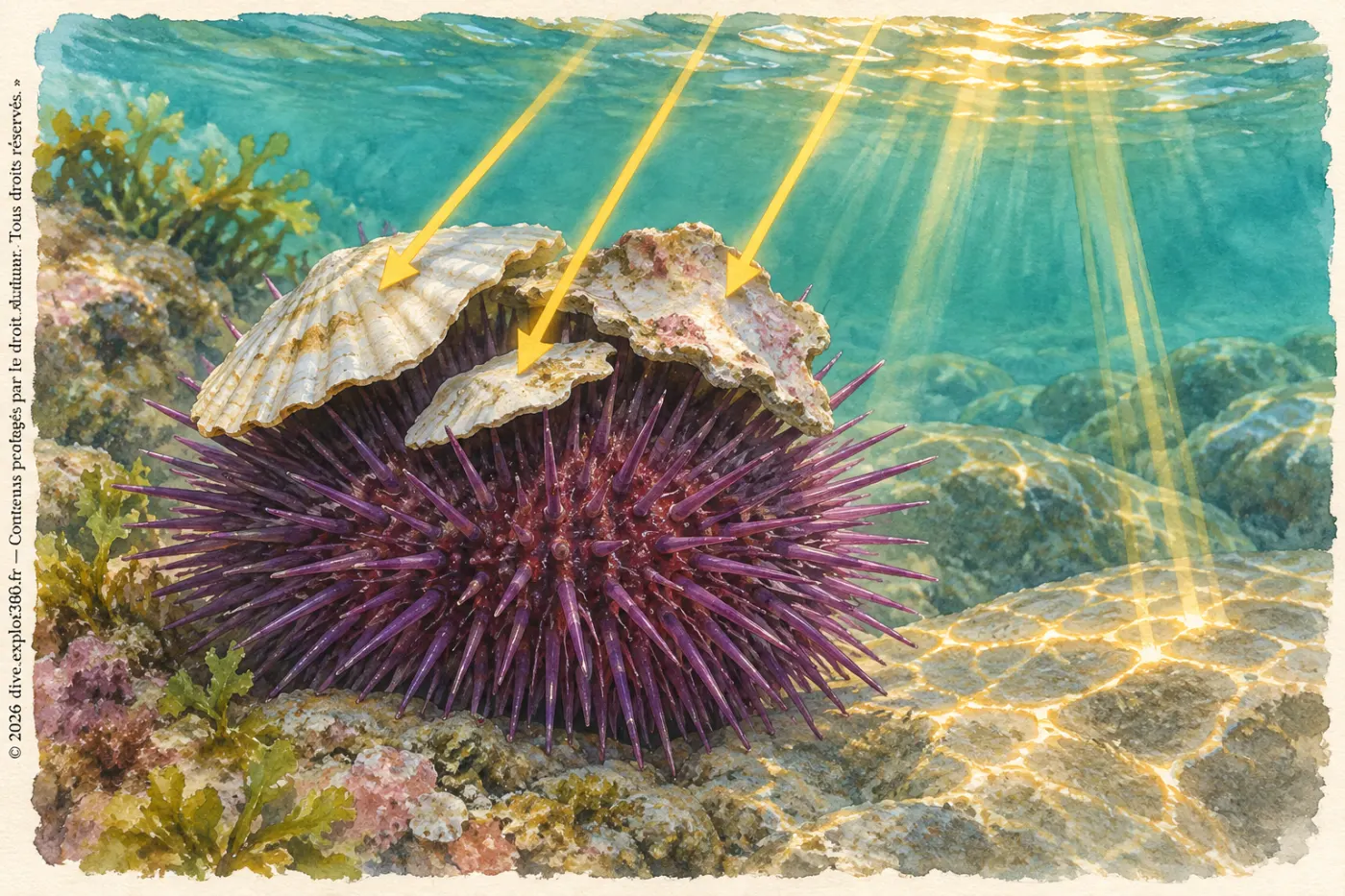
Opaque material intercepts some radiation. Arrows explain the principle; they show neither a measured dose nor a function established for every urchin species.
Opaque material intercepts some radiation. Arrows explain the principle; they show neither a measured dose nor a function established for every urchin species. © 2026 dive.explo360.fr — Contenus protégés par le droit d’auteur. Tous droits réservés.
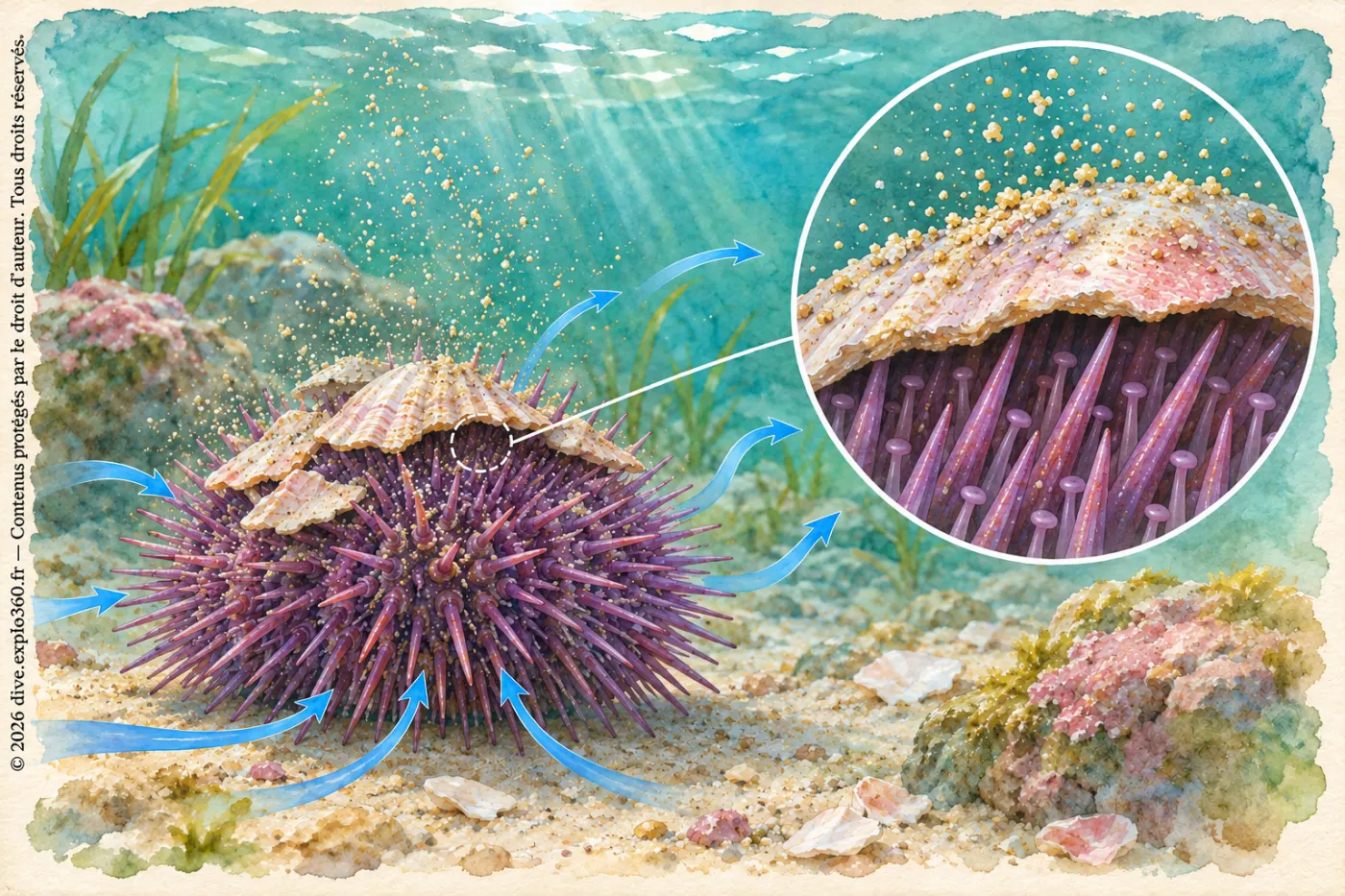
The umbrella hypothesis proposed by Richner and Milinski: fragments may reduce deposits on the upper body. The enlarged view is explanatory, not an anatomical section.
The umbrella hypothesis proposed by Richner and Milinski: fragments may reduce deposits on the upper body. The enlarged view is explanatory, not an anatomical section. © 2026 dive.explo360.fr — Contenus protégés par le droit d’auteur. Tous droits réservés.

A roof against drifting sand

In an experiment published in 2000, purple sea urchins at Banyuls-sur-Mer added more shells when sand was floating in the water. Scientists suggested that shells act like little roofs, keeping some grains off the upper body.

Choosing the useful pieces

Tropical collector urchins given different pieces in a test preferred opaque ones to clear ones. They covered themselves more in bright light too. Useful choices do not mean they understand the science of sunlight.
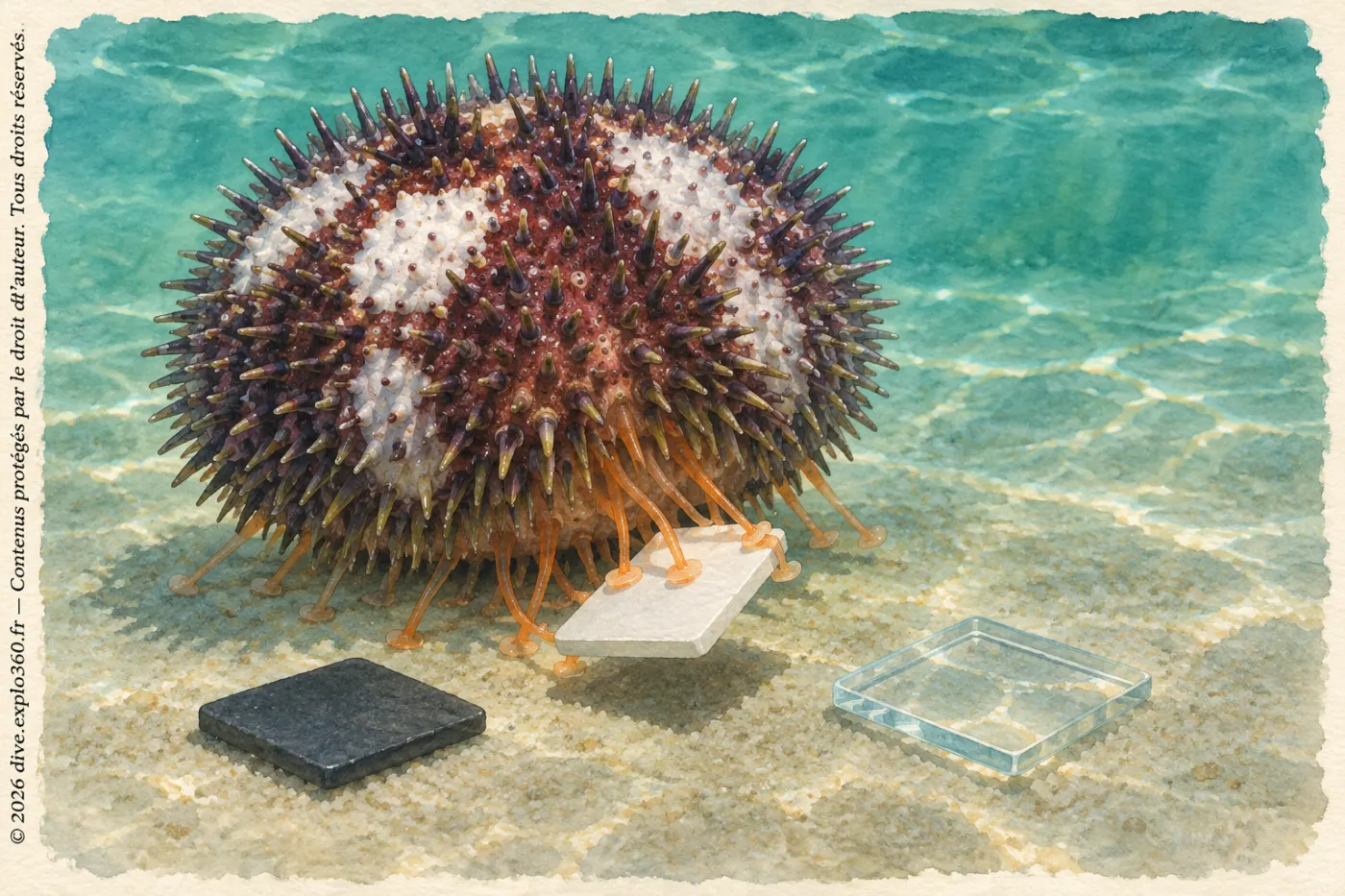
A simplified illustration of Tripneustes gratilla tests, in which opacity and light influenced covering. This is not an exact reconstruction of the apparatus or procedure.
A simplified illustration of Tripneustes gratilla tests, in which opacity and light influenced covering. This is not an exact reconstruction of the apparatus or procedure. © 2026 dive.explo360.fr — Contenus protégés par le droit d’auteur. Tous droits réservés.
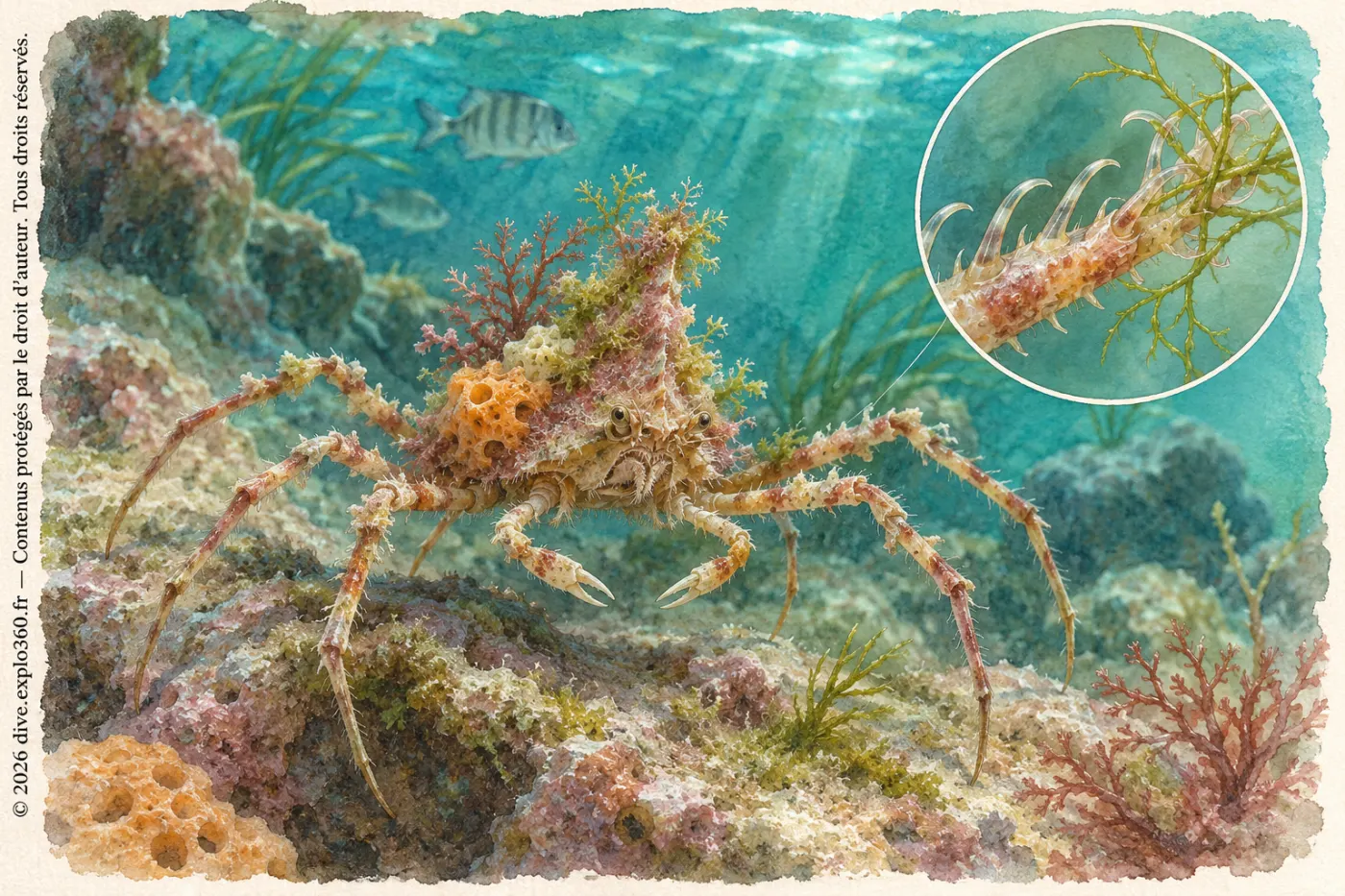
Inachus phalangium decorated with algae and sponges. Hooked bristles are shown separately at an enlarged scale.
Inachus phalangium decorated with algae and sponges. Hooked bristles are shown separately at an enlarged scale. © 2026 dive.explo360.fr — Contenus protégés par le droit d’auteur. Tous droits réservés.

A walking disguise

A decorator crab wears bits of algae or sponge. It prepares them with claws and mouthparts, then presses them onto hooked hairs. These work rather like hook-and-loop fastening. The pieces stay attached while the crab walks and feeds.

Borrowing an alga’s defences

Young Libinia dubia crabs in North Carolina choose a brown alga that many fish dislike. In 1999, a study found fewer fatal attacks on crabs wearing it than on those with another alga. They showed little interest in eating their protective decoration. Large adults had less need for it.
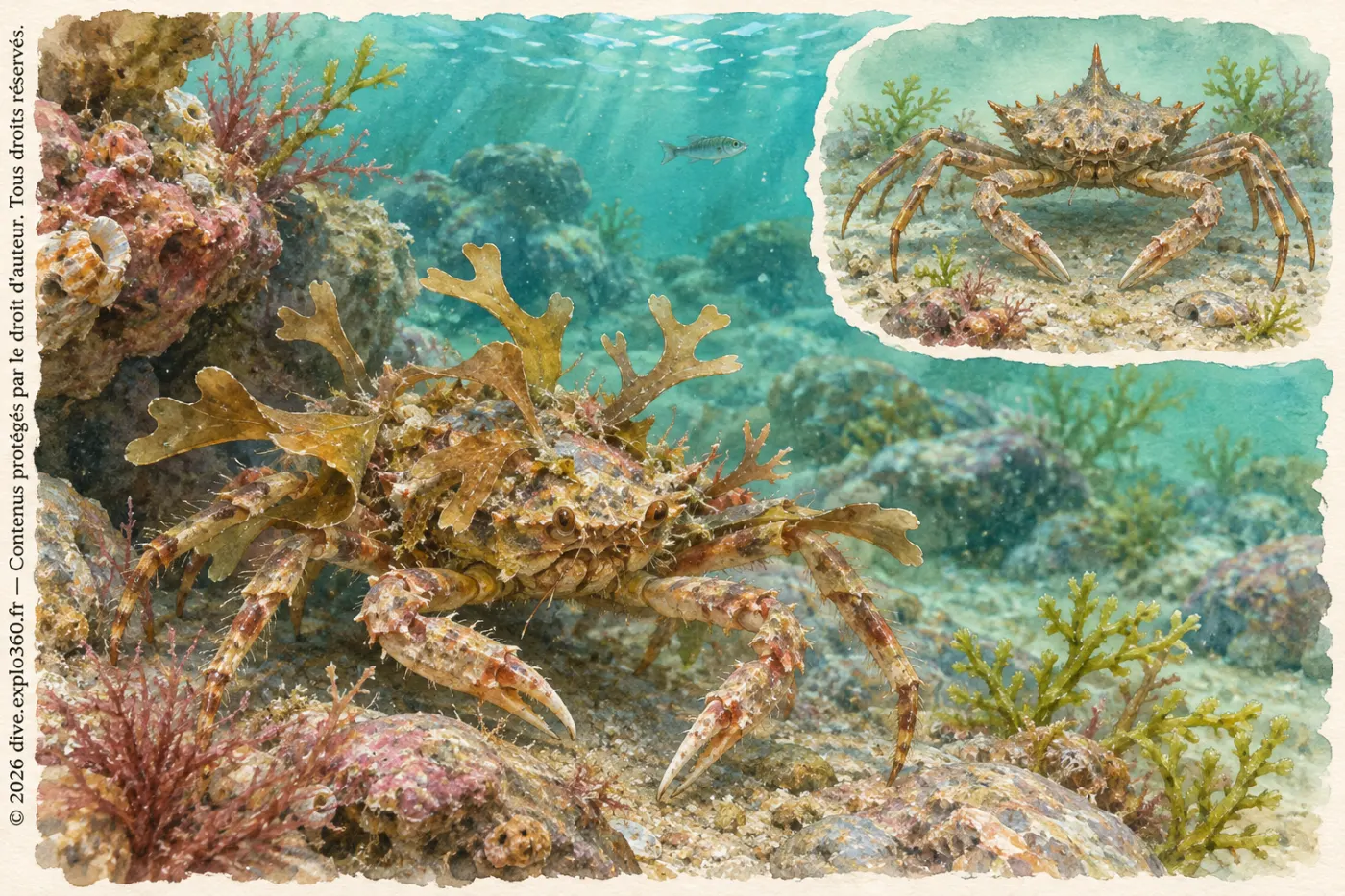
Libinia dubia with Dictyota menstrualis. The views use different scales. Experiments distinguished material chosen for decoration from food preferences and effects on survival.
Libinia dubia with Dictyota menstrualis. The views use different scales. Experiments distinguished material chosen for decoration from food preferences and effects on survival. © 2026 dive.explo360.fr — Contenus protégés par le droit d’auteur. Tous droits réservés.

GO FURTHER WITH AMIGANSEAU

Continue reading

Discover full species guides, in-depth content and interactive tools available with your licence.

Your subscription helps preserve our independence.

Dive.Explo360 is an independent, self-funded nonprofit. Every licence helps us create new content, improve our teaching tools and keep some of our resources free and ad-free.

Licences from €80 per year

Choose a licence that suits your needs for personal, educational or professional use.

Open-access resources remain available without a subscription.

Scientific references

Richner, H. & Milinski, M. (2000). On the functional significance of masking behaviour in sea urchins — an experiment with Paracentrotus lividus. Marine Ecology Progress Series, 205, 307–308doi.orgSigg, J. E., Lloyd-Knight, K. M. & Boal, J. G. (2007). UV radiation influences covering behaviour in the urchin Lytechinus variegatus. Journal of the Marine Biological Association of the United Kingdom, 87, 1257–1261doi.orgZiegenhorn, M. A. (2016). Best Dressed Test: A Study of the Covering Behavior of the Collector Urchin Tripneustes gratilla (2016)pmc.ncbi.nlm.nih.govTool Use by Four Species of Indo-Pacific Sea Urchins (2019). Journal of Marine Science and Engineering, 7, 69doi.orgDrivers and functional consequences of covering in a pervasive marine grazer (green sea urchin, Strongylocentrotus droebachiensis) (2026)doi.orgUse of sponges in the decoration of Inachus phalangium (Decapoda, Majidae) from the Adriatic Sea (2006)doi.orgStachowicz, J. J. & Hay, M. E. (1999). Reducing predation through chemically mediated camouflage: indirect effects of plant defenses on herbivores. Ecology, 80, 495–509doi.orgStachowicz, J. J. & Hay, M. E. (2000). Geographic Variation in Camouflage Specialization by a Decorator Crab. The American Naturalist, 156, 59–71doi.orgThe evolutionary ecology of decorating behaviour (2015)pmc.ncbi.nlm.nih.govFinn, J. K., Tregenza, T. & Norman, M. D. (2009). Defensive tool use in a coconut-carrying octopus. Current Biology, 19, R1069–R1070doi.orgMann, J. & Patterson, E. M. (2013). Tool use by aquatic animals. Philosophical Transactions of the Royal Society Bpmc.ncbi.nlm.nih.govHow intelligent is a cephalopod? Lessons from comparative cognition (2021). Biological Reviewsdoi.orgRoss, D. M. (1971). Protection of hermit crabs (Dardanus spp.) from octopus by commensal sea anemones (Calliactis spp.). Nature, 230, 401–402doi.orgHarada, K., Hayashi, N. & Kagaya, K. (2020). Individual behavioral type captured by a Bayesian model comparison of cap making by sponge crabs. PeerJ, 8, e9036doi.orgEffects of shell condition and size upon the shell choice behavior of a hermit crab (1985). Journal of Experimental Marine Biology and Ecology, 88, 271–285doi.orgZhu Min-Da (1984). Le phénomène d’agglutination dans le genre Xenophora. Nouvelles archives du Muséum d’histoire naturelle de Lyon, 22, 3–50www.persee.frKrützen, M. et al. (2005). Cultural transmission of tool use in bottlenose dolphins. PNAS, 102, 8939–8943doi.org