Partners and Dive.Explo360 explorers

Contact us

Verification code

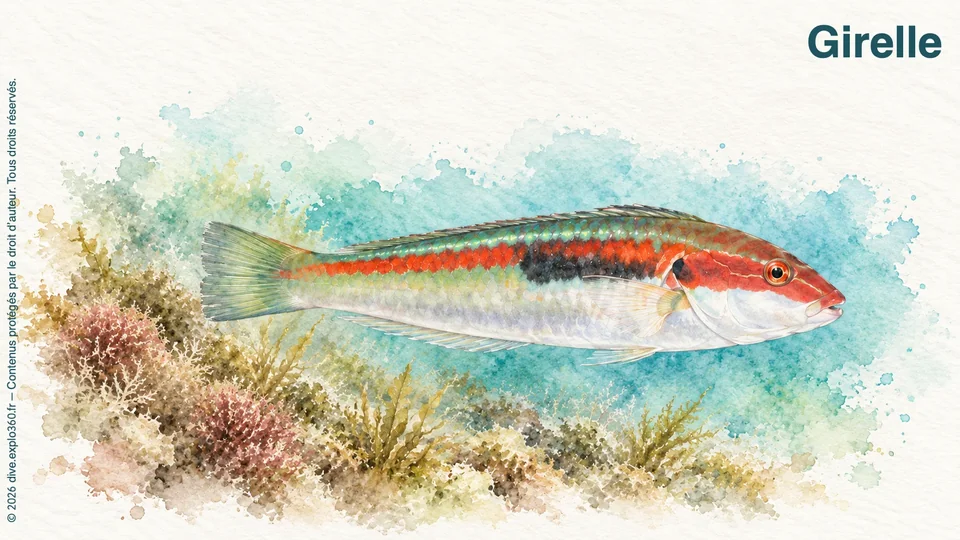
Mediterranean Rainbow Wrasse

Distribution : Mediterranean

Almost two thousand years ago, the Romans wrote about a little fish called iulis. Today, some researchers think it might have been the Mediterranean rainbow wrasse. Imagine finding a colourful fish among the rocks that may already have appeared in books from ancient Rome!

Habitat of Mediterranean Rainbow Wrasse Habitat
Wreck, Sand, Seagrass meadow, Rocky habitat
Depth range of Mediterranean Rainbow Wrasse Depth
1-100 m
Biological group of Mediterranean Rainbow Wrasse Group
Ecological role of Mediterranean Rainbow Wrasse Role
Predator

Average size

15 cm

Good to know

In this species, the male has brighter colours than the female.

WHAT DOES IT LOOK LIKE?

The Mediterranean rainbow wrasse has a slim, elongated body. Females have a white stripe beneath a brown back. Some males are much more colourful, with a green or blue back and an orange zigzag along the side.

GO FURTHER WITH AMIGANSEAU

Explore the full species guide

Discover full species guides, in-depth content and interactive tools available with your licence.

Your subscription helps preserve our independence.

Dive.Explo360 is an independent, self-funded nonprofit. Every licence helps us create new content, improve our teaching tools and keep some of our resources free and ad-free.

Licences from €80 per year

Choose a licence that suits your needs for personal, educational or professional use.

Open-access resources remain available without a subscription.
Mediterranean Rainbow Wrasse

Understand the species

What is this species’ ecological role?

AMIGANSEAU Explorer Premium

Access enriched species profiles with advanced content (audio, infographics and detailed articles).

Explore all species easily through a single interface.

Enjoy a smooth, fast learning experience suited to every level.

🔒 The full profile is available with a paid subscription only.

Discover licences

POURSUIVRE L’EXPLORATION

Articles related to this species

ArticleDo fish recognise us?Read the article →