


 Habitat
 Depth
 Group
 Role
 Average size
WHAT DOES IT LOOK LIKE?
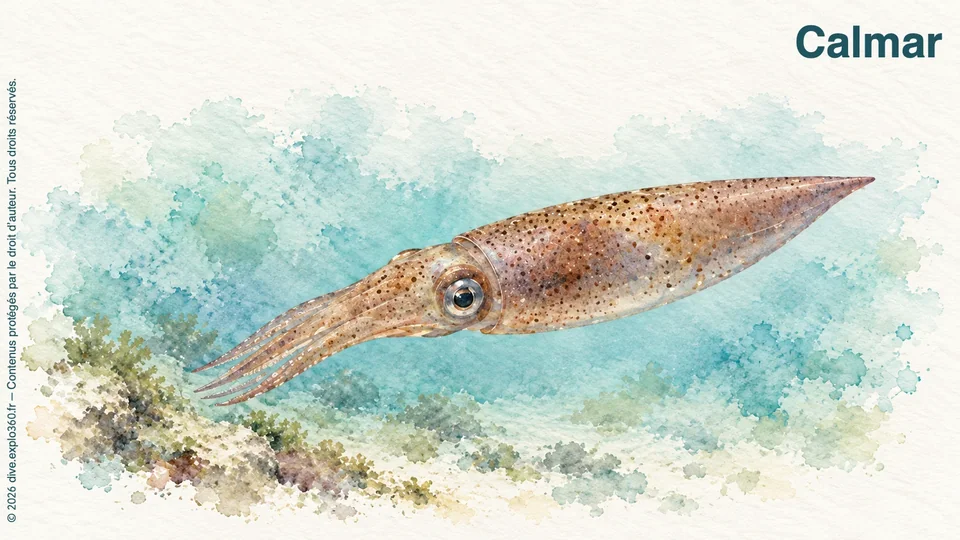
The European squid (Loligo vulgaris) has two fins that form a diamond at the rear of its body. They span about two-thirds of the mantle, the long part of the body behind the head.
Large eyes and eight short arms stand out on the head. The two tentacles, extensions longer than the arms, may remain out of view. Skin colour changes rapidly, with pink or brown shades among its appearances and some light passing through the body.
WHERE DOES IT LIVE?
The European squid lives in the Mediterranean Sea and the eastern Atlantic. It moves both near the seabed and in open water.
It occurs from the surface down to several hundred metres, often above sandy or muddy seabeds.
Depending on the season, it may approach the coast.
WHAT DOES IT EAT?
The European squid’s tentacles make the capture, while its arms hold food before the mouth. The horny beak then cuts tissues into fragments for ingestion. This sequence explains why prey can remain visible among the arms after a rapid capture. Fish are important in the diet, and other cephalopods are also eaten. Very young squid take minute crustaceans, with prey size and identity changing during development.
GO FURTHER WITH AMIGANSEAU
Unlock the full profile
Deepen your knowledge with the exclusive chapters and interactive resources included in an AMIGANSEAU licence.
Subscribing to Dive.Explo360 means supporting a different way to discover marine life.
Our independent platform is entirely self-funded and relies solely on subscriptions. Every licence helps us continue our work, create new content, and share what we know about the marine world with as many people as possible.
Starting at €80 per year, your support makes all the difference.
 Understand the species