Habitat
 Depth
 Group
 Role
 Average size
WHAT DOES IT LOOK LIKE?
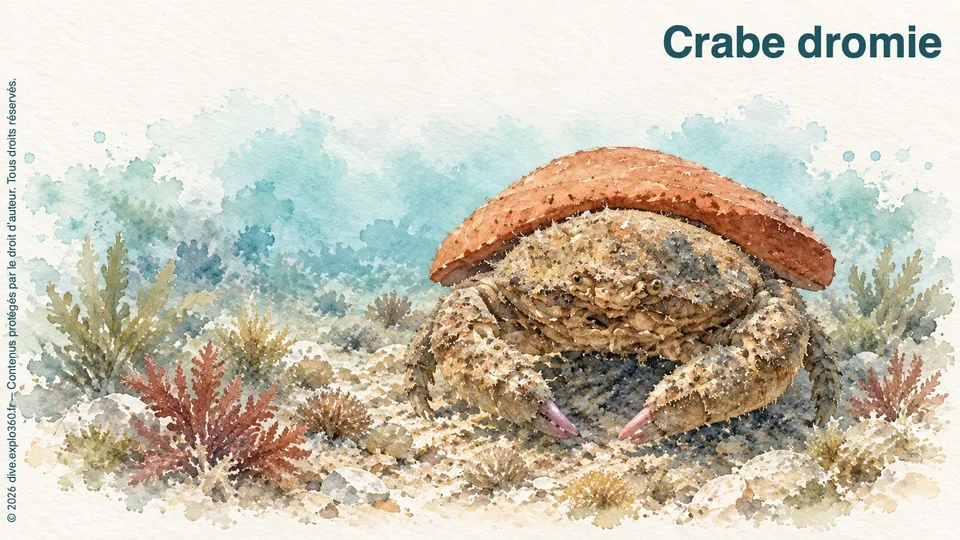
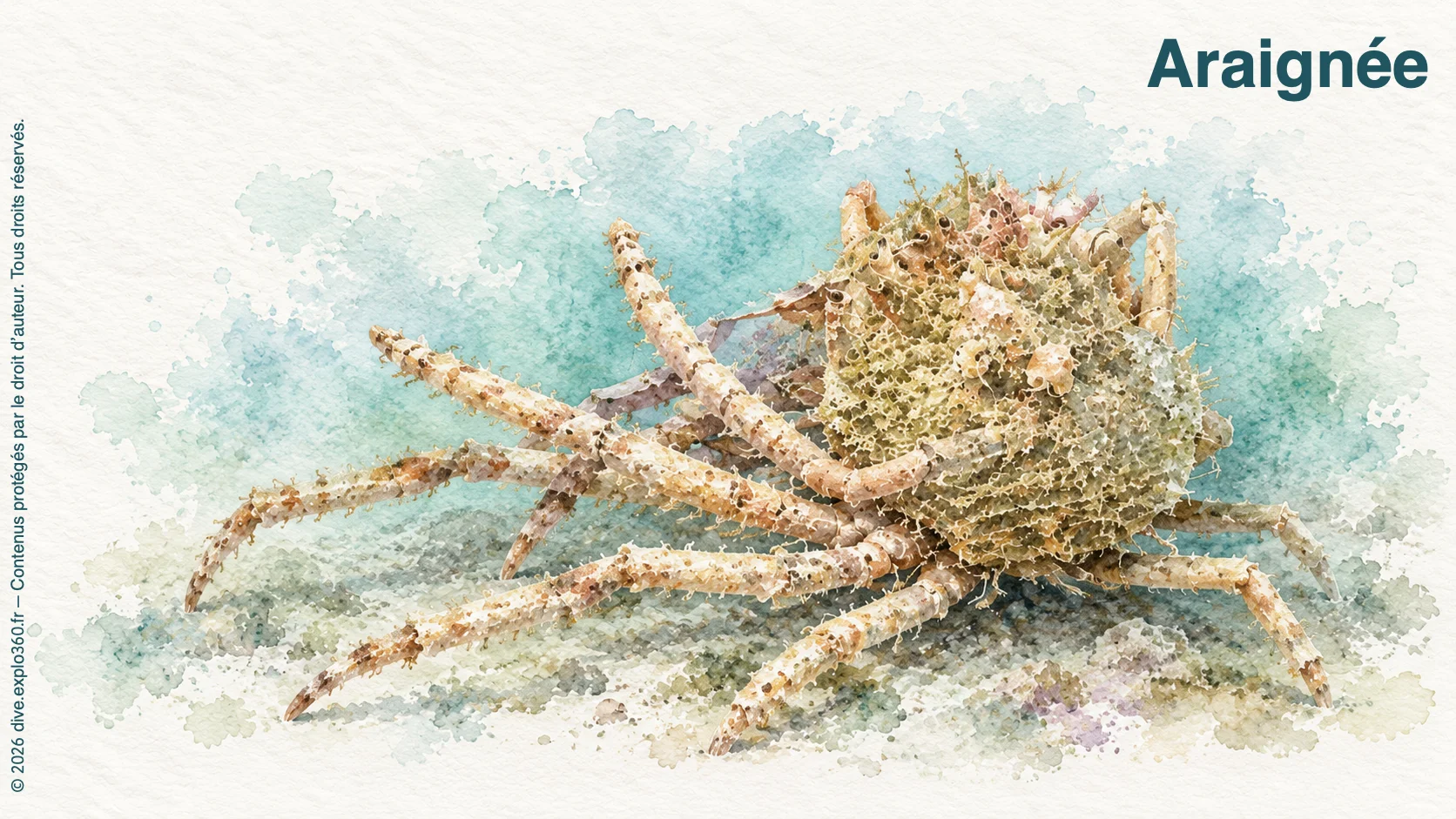
The sponge crab (Dromia personata) can be almost hidden by what it carries on its back. Its last two pairs of legs are short and point upwards, holding a sponge or another organism over the shell.
Beneath it is a rounded crab with a strongly domed shell and stocky proportions. Brown to purplish hairs give the body and legs a velvety appearance. The heavy claws have the same covering except at their ends, where smooth, pale pink to mauve fingers stand out.
WHERE DOES IT LIVE?
The sponge crab is found in the Mediterranean Sea and nearby Atlantic. It lives on different types of seabed, whether rocky, sandy or covered in debris.
It often inhabits areas rich in attached organisms, between a few metres and around a hundred metres deep.
Inconspicuous, it remains hidden beneath stones or in hollows during the day and becomes more active at night.
WHAT DOES IT EAT?
The sponge crab feeds on small animals that it grasps with its claws and brings to its mouth. Its prey can include seabed invertebrates such as small molluscs and marine worms. It usually searches for food at night, when it leaves its shelter. The sponge carried on its back serves as camouflage: the crab holds it with its last two pairs of legs rather than bringing it to its mouth to eat.
GO FURTHER WITH AMIGANSEAU
Unlock the full profile
Deepen your knowledge with the exclusive chapters and interactive resources included in an AMIGANSEAU licence.
Subscribing to Dive.Explo360 means supporting a different way to discover marine life.
Our independent platform is entirely self-funded and relies solely on subscriptions. Every licence helps us continue our work, create new content, and share what we know about the marine world with as many people as possible.
Starting at €80 per year, your support makes all the difference.
 Understand the species