


 Habitat
 Depth
 Group
 Role
 Average size
 Good to know
WHAT DOES IT LOOK LIKE?
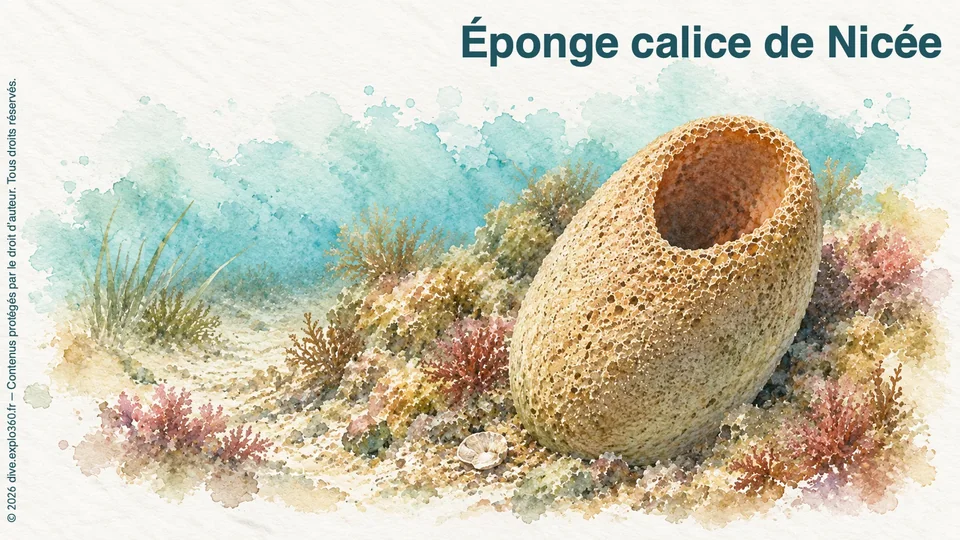
This brown to olive sponge (Calyx nicaeensis) widens above a short, narrow base. Its thick walls form a cup or vase.
The surface looks rough and fibrous. Small openings, the oscules, are inconspicuous within the wall and distinct from the broad hollow open at the top.
WHERE DOES IT LIVE?
It mainly lives on hard substrates such as rocks, drop-offs and coralligenous formations. It can also attach in mixed areas containing sediment, but remains associated with solid supports. It is mostly found in dimly lit areas.
WHAT DOES IT EAT?
The goblet sponge feeds by filtering seawater. Water enters through tiny pores distributed across the outer surface of its walls. Inside, cells bearing small moving filaments maintain the flow and trap bacteria, single-celled algae and fine organic particles. Filtered water leaves through small openings on the inner surface of the cup. The large central cavity may collect sand or shell fragments, but it does not serve to capture food.
GO FURTHER WITH AMIGANSEAU
Unlock the full profile
Deepen your knowledge with the exclusive chapters and interactive resources included in an AMIGANSEAU licence.
- HOW DOES IT REPRODUCE?
- OUR OBSERVATIONS
- ARTICLE
Also included in the full profile
- Advanced navigation between description, ecological context, observations and behaviour
- Interactive food chain to explore the species’ feeding relationships
- Infographic and illustrated summary profile
 Understand the species