Habitat
 Depth
 Group
 Role
 Average size
WHAT DOES IT LOOK LIKE?
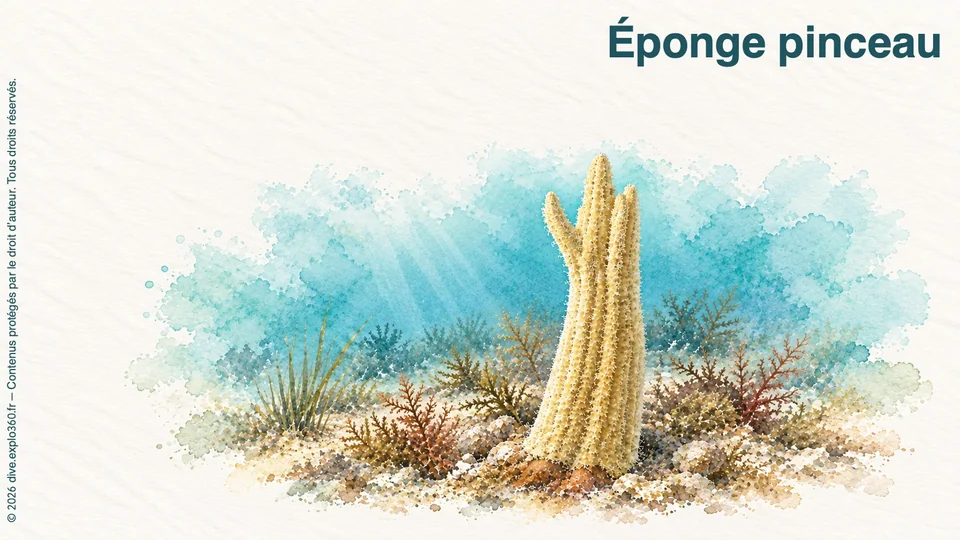
The cored chimney sponge (Ciocalypta penicillus) has cone-shaped projections called papillae. Each has a translucent, slightly ridged wall through which you can see its central core.
Creamy white, creamy yellow and grey shade these little brushes rising from a shared base. Their pale walls reveal the denser core of the projections.
WHERE DOES IT LIVE?
It occurs on stable soft bottoms such as shelly sand or maerl beds, as well as detrital substrates. It occurs in areas exposed to moderate currents.
WHAT DOES IT EAT?
The brush sponge feeds by filtering seawater. Internal cells trap bacteria and fine organic particles carried by the water. Its base is often buried in sand, while upright papillae remain visible. Some bear an osculum at the tip, an opening through which filtered water is expelled. Food is captured within the tissues, not by the papillae themselves.
GO FURTHER WITH AMIGANSEAU
Explore the full species guide
Discover full species guides, in-depth content and interactive tools available with your licence.
Dive.Explo360 is an independent, self-funded nonprofit. Every licence helps us create new content, improve our teaching tools and keep some of our resources free and ad-free.
Choose a licence that suits your needs for personal, educational or professional use.
Open-access resources remain available without a subscription.
 Understand the species