
 Habitat
  Depth
Depth  Group
Group  Role
Role WHAT DOES IT LOOK LIKE?
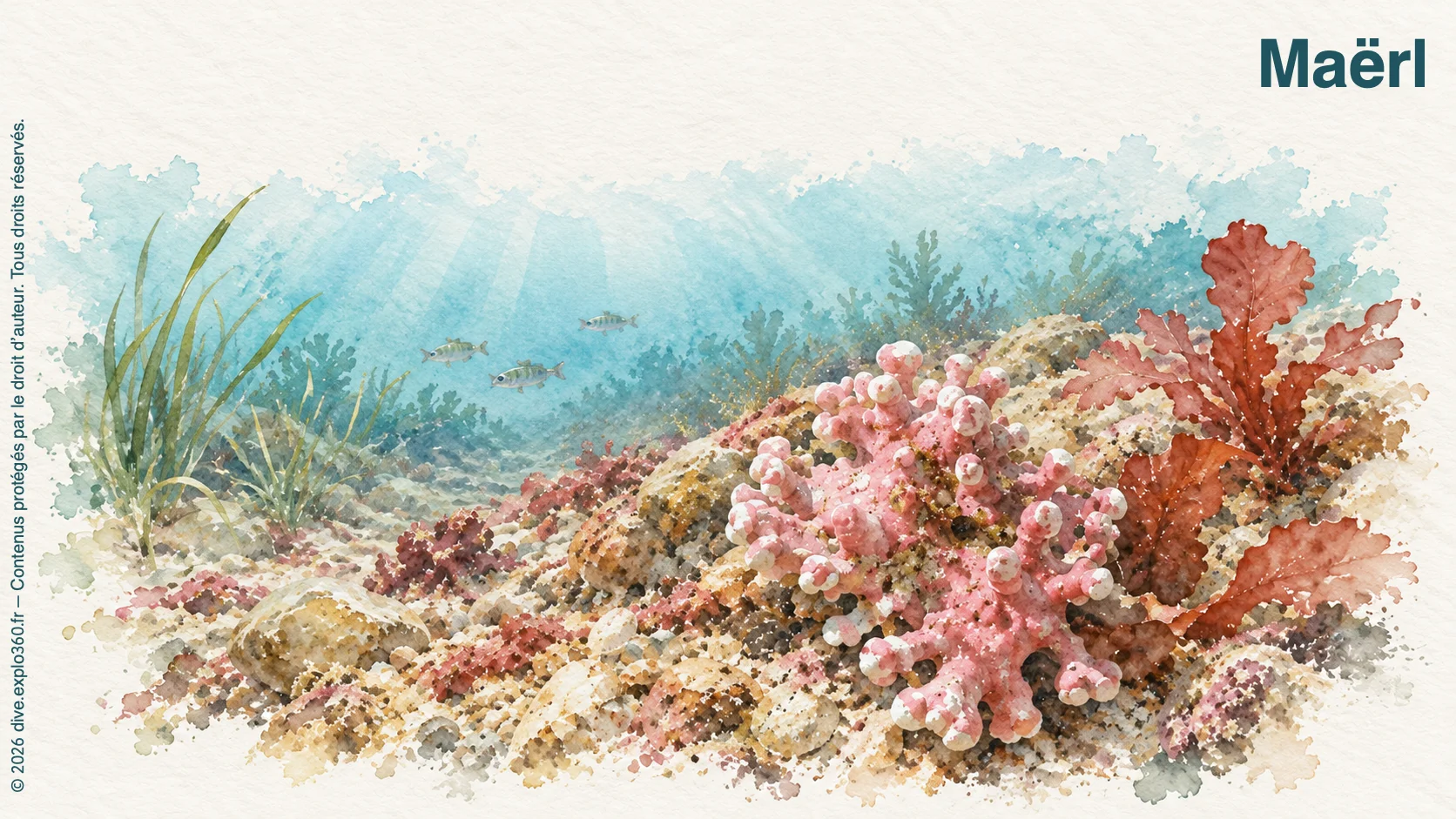
Maerl resembles small fragments of pink stone, but is actually a calcareous red alga. Unattached to the seabed, it takes the form of small stiff, branching pieces. Its colour varies from pink to purple and turns white when dead. It grows extremely slowly, around a few millimetres a year. As the fragments accumulate, they form beds sheltering a great diversity of organisms.WHERE DOES IT LIVE?
Maerl lives on soft seabeds such as sand or gravel in well-lit areas. It is generally found from a few metres down to around forty metres deep, depending on water clarity. It grows in environments with good water renewal and moderate hydrodynamics.WHAT DOES IT EAT?
Like all algae, maerl produces its own organic matter through photosynthesis. It uses light, carbon dioxide and nutrients in the water.GO FURTHER WITH AMIGANSEAU
Unlock the full profile
Deepen your knowledge with the exclusive chapters and interactive resources included in an AMIGANSEAU licence.
- HOW DOES IT REPRODUCE?
- OUR OBSERVATIONS
- UNDERSTAND THE SPECIES
Also included in the full profile
- Advanced navigation between description, ecological context, observations and behaviour
- Interactive food chain to explore the species’ feeding relationships
- Infographic and illustrated summary profile