


 Habitat
 Depth
 Group
 Role
 Average size
WHAT DOES IT LOOK LIKE?
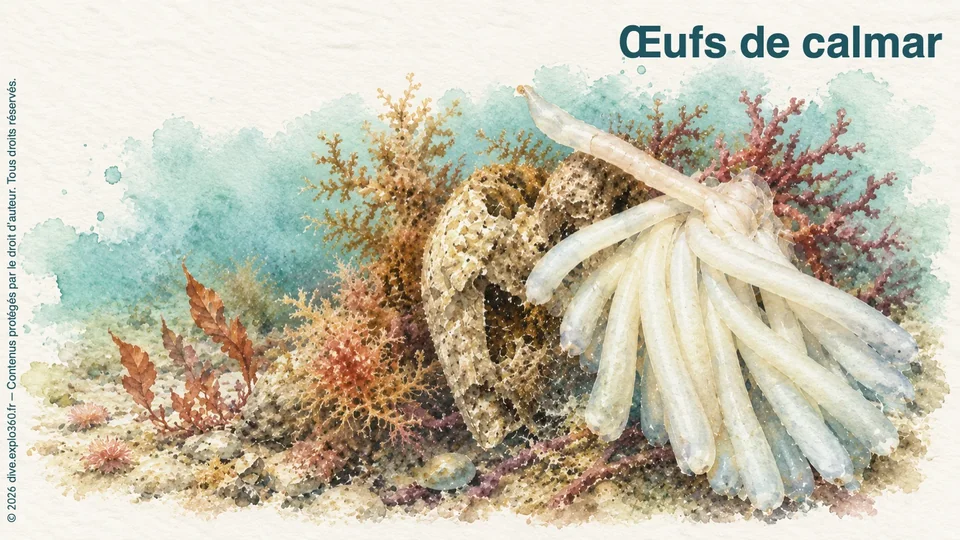
Long jelly-like fingers form close bunches of squid eggs (Loligo spp.). Each finger is a capsule holding many little eggs. Whitish colouring gives way to increasing transparency, through which embryos, the young squid within the eggs, become visible. Several species are grouped here, as “spp.” indicates.
WHERE DOES IT LIVE?
On a rock, alga or other seabed structure, egg clusters remain attached where water flows past. Their position combines an attachment surface with water circulation around the capsules. These eggs do not drift freely in the water column.
WHAT DOES IT EAT?
Before its first captures, a squid has food already present in the egg. Yolk supports embryonic growth by supplying nutrients and energy. The reserve is progressively consumed as body parts form. Even once arms and eyes are recognisable, nourishment still comes from this provision. Eggs do not filter plankton to feed the young: at this stage nutrients come from internal reserves.
GO FURTHER WITH AMIGANSEAU
Unlock the full profile
Deepen your knowledge with the exclusive chapters and interactive resources included in an AMIGANSEAU licence.
Subscribing to Dive.Explo360 means supporting a different way to discover marine life.
Our independent platform is entirely self-funded and relies solely on subscriptions. Every licence helps us continue our work, create new content, and share what we know about the marine world with as many people as possible.
Starting at €80 per year, your support makes all the difference.

 Understand the species