


 Habitat
 Depth
 Group
 Role
 Average size
WHAT DOES IT LOOK LIKE?
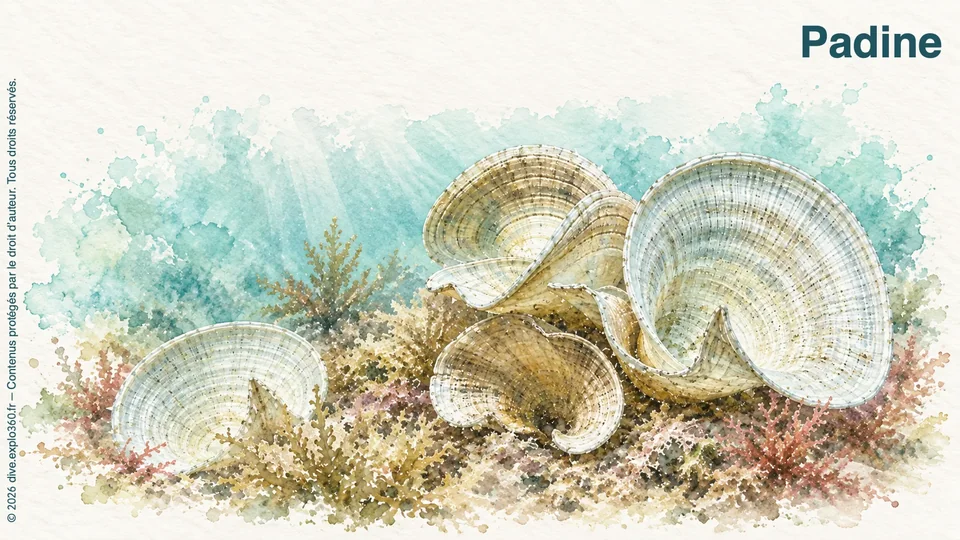
The pale bands of peacock’s tail (Padina pavonica) follow the curves of its fans. They alternate with brown and emphasise the sheets curling into little cones.
A deposit of calcareous mineral material on the surface accounts for the whitish appearance of some areas. Several fans together give the tuft overlapping folds.
WHERE DOES IT LIVE?
It lives in well-lit areas, most often on shallow rocks or hard substrates. It is found in calm to moderately disturbed waters, where light enables photosynthesis.
WHAT DOES IT EAT?
The little fans of peacock’s-tail seaweed are living surfaces in contact with water. Photosynthesis uses light energy to produce organic material from dissolved carbon. The alga also takes up mineral nutrients required by its cells. Nutrition involves internal production supported by exchange with surrounding water. Whitish calcified areas belong to the same thallus, but mineral deposition differs from the organic production that nourishes the alga.
GO FURTHER WITH AMIGANSEAU
Unlock the full profile
Deepen your knowledge with the exclusive chapters and interactive resources included in an AMIGANSEAU licence.
Subscribing to Dive.Explo360 means supporting a different way to discover marine life.
Our independent platform is entirely self-funded and relies solely on subscriptions. Every licence helps us continue our work, create new content, and share what we know about the marine world with as many people as possible.
Starting at €80 per year, your support makes all the difference.

 Understand the species