Partners and information

Contact us

Verification code

Striped catfish

Distribution : Red Sea · Halmahera Sea

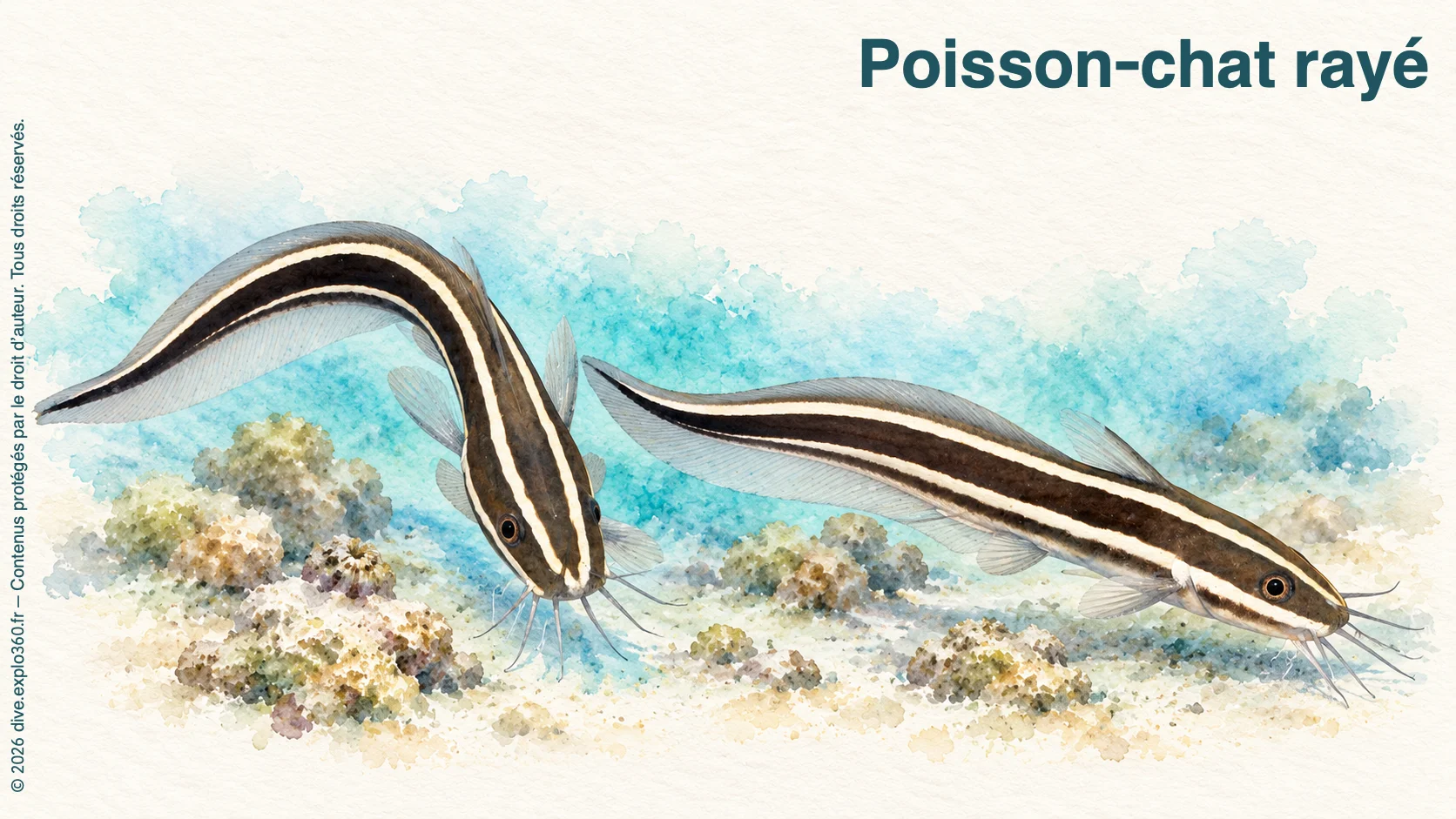
The striped catfish can be recognised by its elongated body, pale stripes and four pairs of barbels around its mouth. Its body tapers towards the rear; the rear dorsal, tail and anal fins form a continuous border. The stripes sometimes become less distinct in large adults. The barbels therefore remain a valuable clue to look for before drawing a conclusion from colour alone.

Habitat of Striped catfish Habitat
Coral reef, Rocky habitat, Sand
Depth range of Striped catfish Depth
1-60 m
Biological group of Striped catfish Group
Ecological role of Striped catfish Role
Predator

WHAT DOES IT LOOK LIKE?

The striped catfish can be recognised by its elongated body, pale stripes and four pairs of barbels around its mouth. Its body tapers towards the rear; the rear dorsal, tail and anal fins form a continuous border. The stripes sometimes become less distinct in large adults. The barbels therefore remain a valuable clue to look for before drawing a conclusion from colour alone.

WHERE DOES IT LIVE?

This Indo-Pacific species uses coral and rocky reefs, coastal seabeds and estuaries. It has also been recorded in the Mediterranean. Young fish frequently form very tight schools; adults are more often solitary or in small groups and may shelter beneath ledges. Observing these changes reveals how use of the environment develops through life.

WHAT DOES IT EAT?

Its diet consists mainly of bottom-dwelling invertebrates, including crustaceans, molluscs and worms; small fish may supplement it. The barbels contribute to sensory exploration of the substrate. The striped catfish thus connects animals living in or on the sediment with the fish food web. When observing it, proximity to the bottom provides context but does not by itself reveal which prey it is seeking.

HOW DOES IT REPRODUCE?

Males and females are separate, and fertilisation is external. The male prepares a nest beneath rocks or large debris, then guards the eggs until they hatch. The larvae are planktonic. This transition from bottom-associated eggs to larvae living in the water highlights the variety of environments involved in the life cycle. A school of young fish does not, however, tell us where spawning occurred.

WATCH WITHOUT DISTURBING

Take time to observe how individuals move within the school, their distance above the bottom and changes in the group’s shape. If possible, compare several sequences before interpreting behaviour. To keep a useful record, note the location, date and visible identification features. The dorsal and pectoral spines are venomous: do not handle the fish, and let the school continue on its way.
Striped catfish

🧠 Understand the species

What is this species’ ecological role?

AMIGANSEAU Explorer Premium

Access enriched species profiles with advanced content (audio, infographics and detailed articles).

Explore all species easily through a single interface.

Enjoy a smooth, fast learning experience suited to every level.

🔒 The full profile is available with a paid subscription only.

Discover licences