


 Habitat
 Depth
 Group
 Role
 Average size
 Good to know
WHAT DOES IT LOOK LIKE?
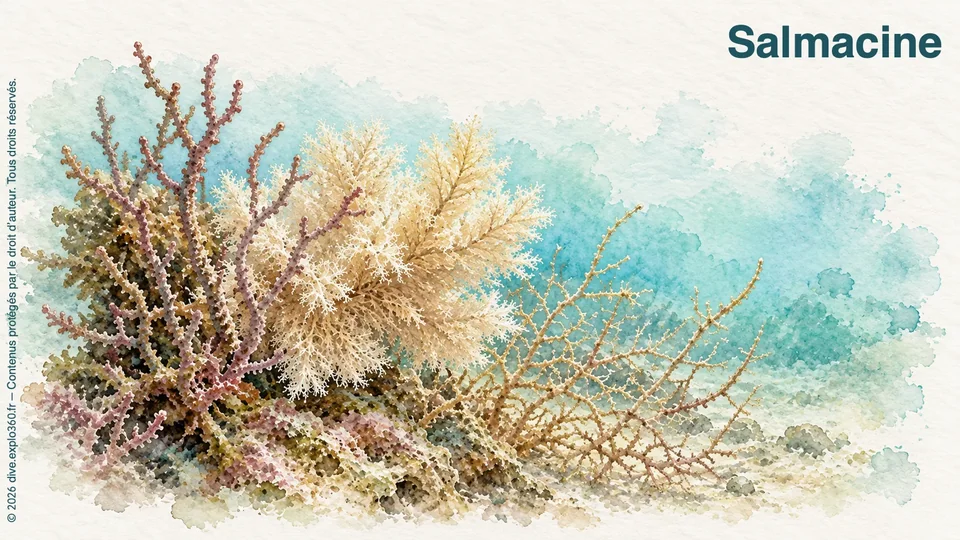
Tangled opaque white tubes give Salmacina (Salmacina dysteri) its appearance. The colony forms an irregular ball of very fine, hard calcareous casings.
The little worms remain almost entirely hidden; their subtle crowns, reddish at the base, may dot the surface. Related worms form comparable masses, limiting certainty when identification rests on this appearance alone.
WHERE DOES IT LIVE?
It grows attached to hard supports: rocks, shells, artificial structures or organisms such as sea fans. It occurs from a few metres deep down to several tens of metres.
WHAT DOES IT EAT?
Food reaches the sagebrush tubeworm in water flowing between its tubes. Each worm exposes a small crown, where mucus retains particles and cilia carry them towards the mouth. The visible cluster therefore contains many individual collecting sites rather than one shared mouth. Food is too small to identify from a distance; expanded crowns mainly reveal feeding apparatus positioned for collection.
GO FURTHER WITH AMIGANSEAU
Unlock the full profile
Deepen your knowledge with the exclusive chapters and interactive resources included in an AMIGANSEAU licence.
Subscribing to Dive.Explo360 means supporting a different way to discover marine life.
Our independent platform is entirely self-funded and relies solely on subscriptions. Every licence helps us continue our work, create new content, and share what we know about the marine world with as many people as possible.
Starting at €80 per year, your support makes all the difference.




 Understand the species