


 Habitat
 Depth
 Group
 Role
 Average size
WHAT DOES IT LOOK LIKE?
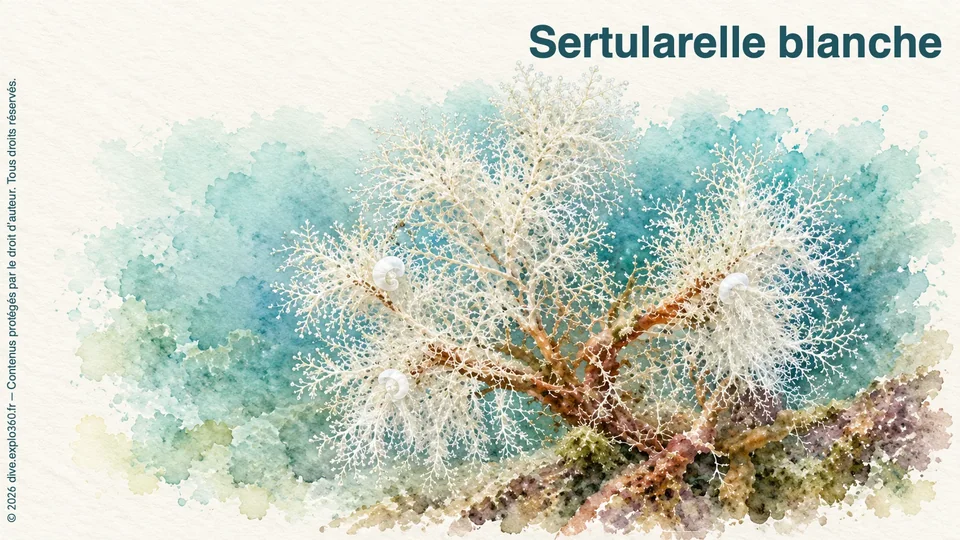
White colouring and open branching shape this hydroid (Sertularella crassicaulis). Around an upright stem, fine branches divide and spread through several planes.
The bush is an animal colony. Small polyps, the connected individuals, line this rigid framework; the overall arrangement is more visible than each tiny animal.
WHERE DOES IT LIVE?
It grows attached to different supports: rocks, coralligenous structures or living organisms such as sea fans. It is generally found between a few metres and several tens of metres deep, in areas with currents.
WHAT DOES IT EAT?
White sertularella hydroid meals occur at the scale of its small polyps. Each exposes tentacles whose capture cells retain passing zooplankton. Prey is brought towards the feeding polyp’s mouth. Water flow supplies food, but stronger currents do not necessarily increase catches, because contact must allow retention. Its menu is described as small planktonic resources; no particular crustacean is established here as the dominant prey.
GO FURTHER WITH AMIGANSEAU
Unlock the full profile
Deepen your knowledge with the exclusive chapters and interactive resources included in an AMIGANSEAU licence.
Subscribing to Dive.Explo360 means supporting a different way to discover marine life.
Our independent platform is entirely self-funded and relies solely on subscriptions. Every licence helps us continue our work, create new content, and share what we know about the marine world with as many people as possible.
Starting at €80 per year, your support makes all the difference.
 Understand the species