


 Habitat
 Depth
 Group
 Role
 Average size
 Precautions
WHAT DOES IT LOOK LIKE?
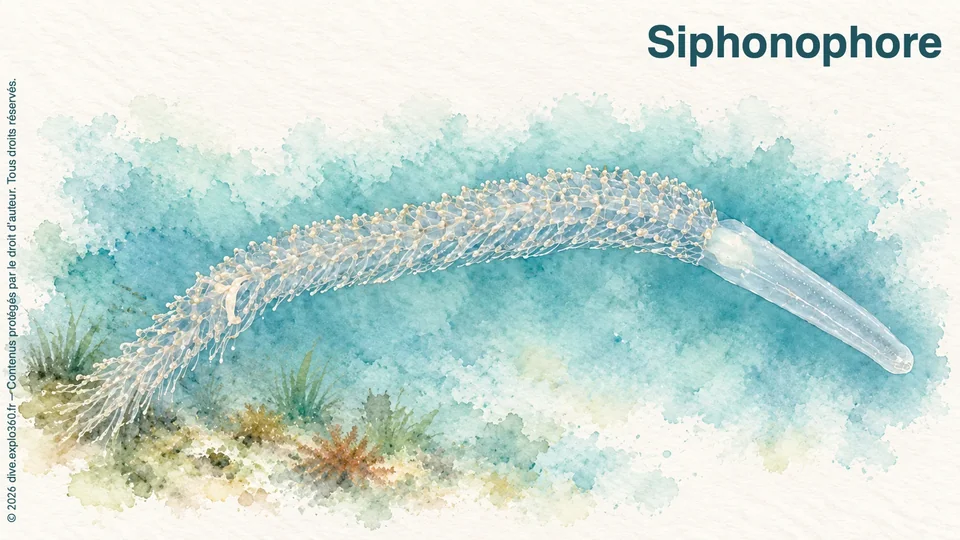
A loosely or tightly coiled spiral turns this siphonophore (Forskalia edwardsi) from a dense sleeve into an open bouquet. Small pink to orange parts and their filaments surround a central axis behind a more transparent front end.
These parts are zooids, the animal units of the colony. Several Forskalia species have similar outlines, making precise identification by sight difficult.
WHERE DOES IT LIVE?
This siphonophore lives in open water, mainly drifting with currents. It can move vertically in the water column but remains dependent on water masses and plankton conditions.
WHAT DOES IT EAT?
The big siphonophore can alternate swimming-bell thrusts with gentle sinking. Tentacles and fishing filaments spread around the colony and intercept small waterborne animals. Nematocysts help retain prey, then filaments contract to bring it towards the gastrozooids. Food includes copepods, crustacean and mollusc larvae, and other plankton organisms; small fish are taken occasionally. Capture is followed by transfer within the colony, where specialised units ingest and digest the meal.
GO FURTHER WITH AMIGANSEAU
Unlock the full profile
Deepen your knowledge with the exclusive chapters and interactive resources included in an AMIGANSEAU licence.
- HOW DOES IT REPRODUCE?
- ARTICLE
Also included in the full profile
- Advanced navigation between description, ecological context, observations and behaviour
- Interactive food chain to explore the species’ feeding relationships
- Infographic and illustrated summary profile
 Understand the species