


 Habitat
 Depth
 Group
 Role
 Average size
WHAT DOES IT LOOK LIKE?
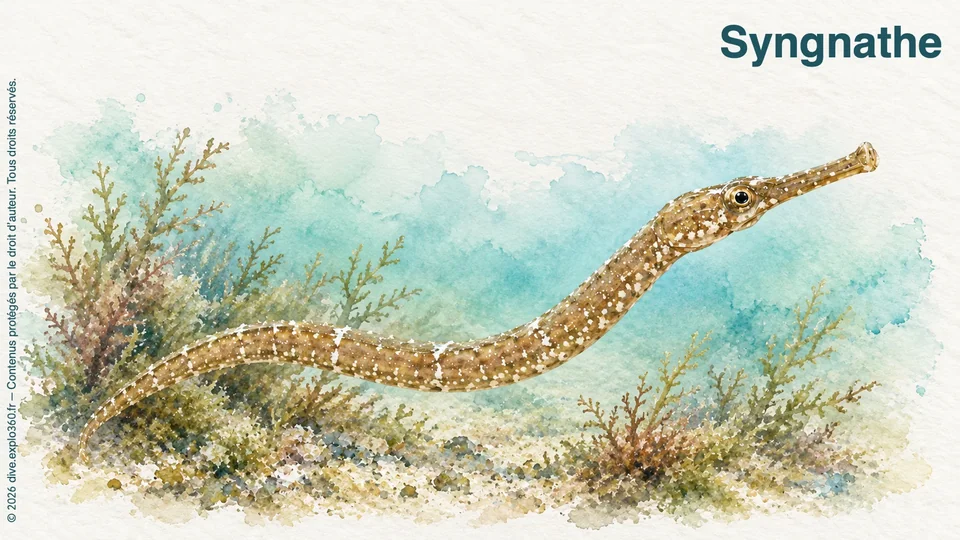
A tubular snout continues the slender line of the greater pipefish (Syngnathus acus). Bony rings, the hard plates surrounding the body, give it a divided, rigid appearance.
Colouring may be brown or green. Mobile eyes at the sides of the head contrast with the almost straight line of this stretched outline.
WHERE DOES IT LIVE?
It is mainly found in seagrass beds, particularly Neptune grass, but also on sandy-muddy seabeds rich in vegetation. It frequents shallow coastal areas where it can easily conceal itself.
WHAT DOES IT EAT?
A small animal disappears at the snout tip as the greater pipefish sucks it in with water. This mechanism captures small crustaceans, notably amphipods, copepods and small shrimps. Their importance varies among sites. Studied Cíes Islands populations rely heavily on amphipods associated with algae and the seabed, while copepods contribute more elsewhere. Foraging can therefore target vegetation-associated fauna as well as animals free in the water. Capture is brief, and the food often too small to identify from a distance.
GO FURTHER WITH AMIGANSEAU
Unlock the full profile
Deepen your knowledge with the exclusive chapters and interactive resources included in an AMIGANSEAU licence.
Subscribing to Dive.Explo360 means supporting a different way to discover marine life.
Our independent platform is entirely self-funded and relies solely on subscriptions. Every licence helps us continue our work, create new content, and share what we know about the marine world with as many people as possible.
Starting at €80 per year, your support makes all the difference.
 Understand the species