A skeleton full of life
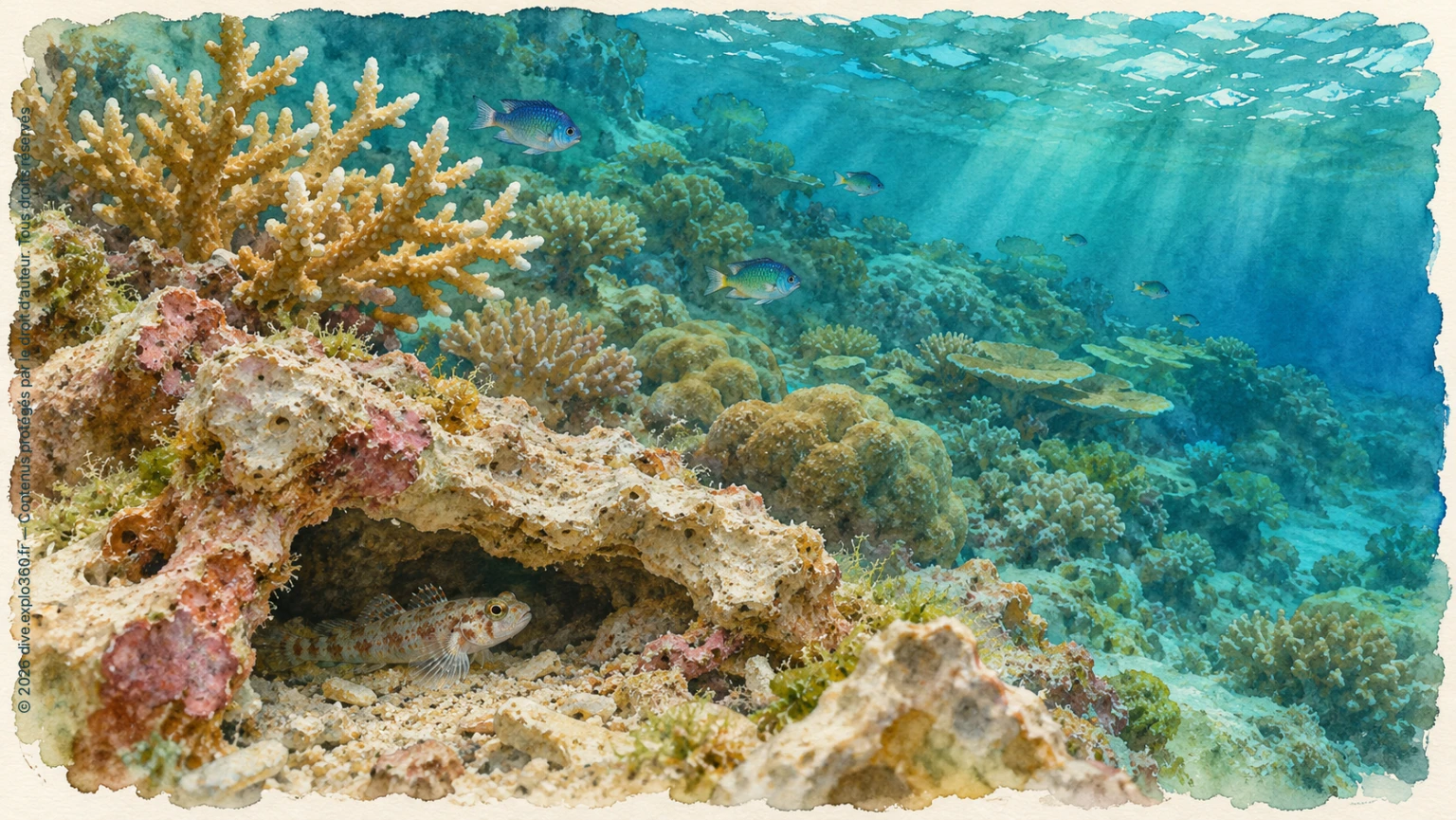
A reef-building coral is a colonial animal made up of polyps. Its polyps deposit a skeleton of calcium carbonate, mainly in the form of aragonite. As the colony grows, it leaves a record of its growth in the mineral framework beneath the living tissue. From the outside, that framework can look solid. Inside are pores and cavities whose size and shape vary with the species and the structure of the colony.
Some of these spaces accommodate microscopic organisms. Bacteria, archaea, fungi and algae can live within the carbonate. Those that live inside the mineral framework are called endoliths, literally “living in stone”. Their presence is not limited to dead skeletons. Under the tissues of a living colony, microbial communities can occupy a large part of the mineral volume.
Not all of them are in direct contact with outside water. Some live in extremely small spaces, where light, oxygen and available resources differ greatly from those on the surface. The skeleton provides a habitat of its own. One of its common inhabitants is a microscopic alga that divers rarely see.
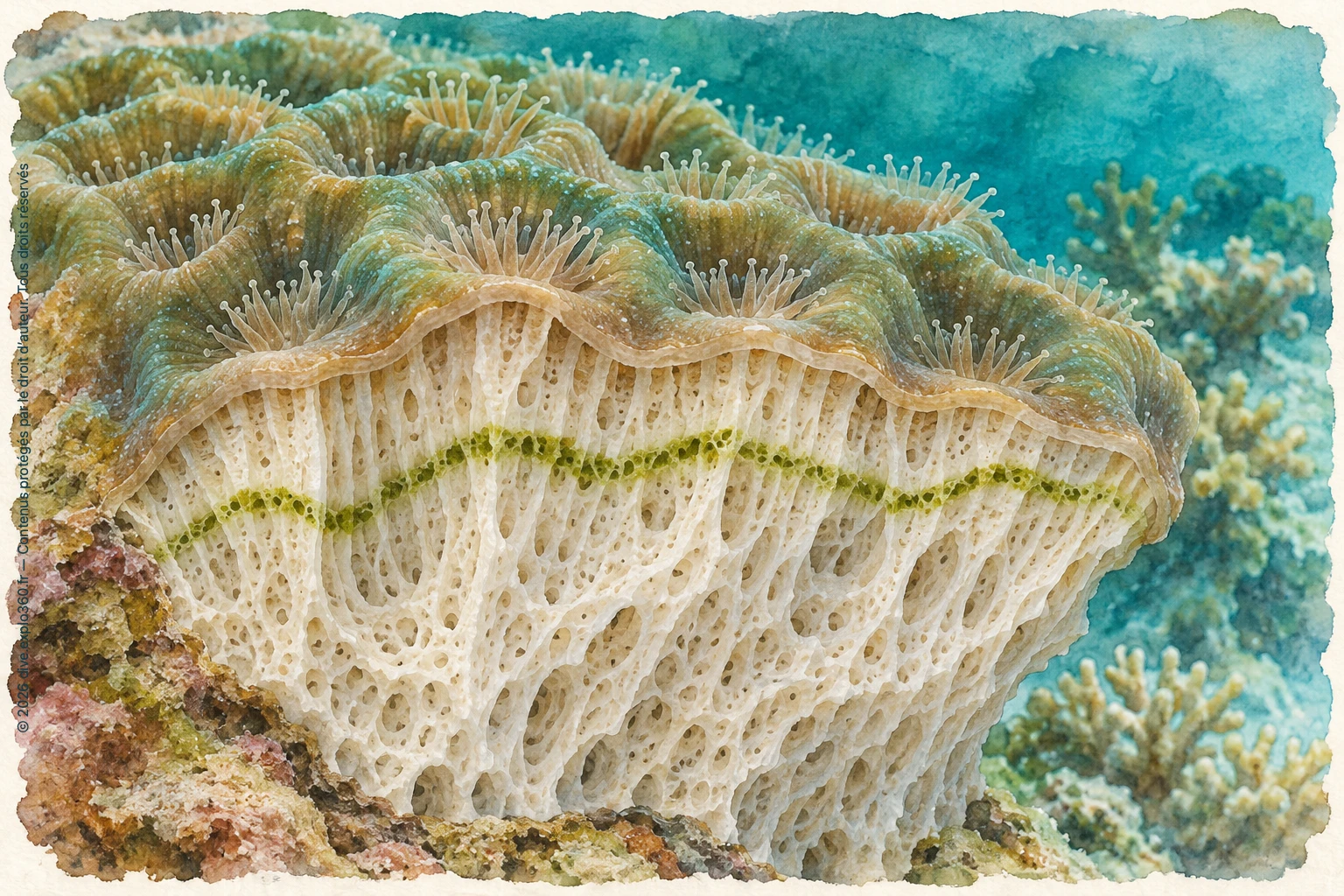
The green band inside the limestone
A section through the skeleton of some corals can reveal a green band beneath the living tissue. This coloration may come from microscopic algae of the genus Ostreobium. Unlike the algae that cover the rocks, Ostreobium develops inside the skeleton. Its filaments grow through the calcium carbonate, where very little light reaches them. The algae are adapted to photosynthesise in very dim light.
Part of the light that passes through coral tissue and enters the skeleton can still be used for photosynthesis. But their activity is not limited to organic matter production. They help move carbon and nutrients through the coral skeleton, where they interact with bacteria and other microorganisms. Under certain experimental conditions, compounds produced by endolithic algae may also be transferred to coral tissues.
This relationship is particularly interesting when corals undergo thermal stress and lose part of their usual photosynthetic symbionts. That transfer could help supply energy to some heat-stressed corals. How much it helps depends on the species and conditions, and its role in the survival of bleached colonies remains uncertain. Even beneath living tissue, the mineral framework supports its own community.
Organisms living in the skeleton continue to change what the coral has built.
Sponges that bore into stone
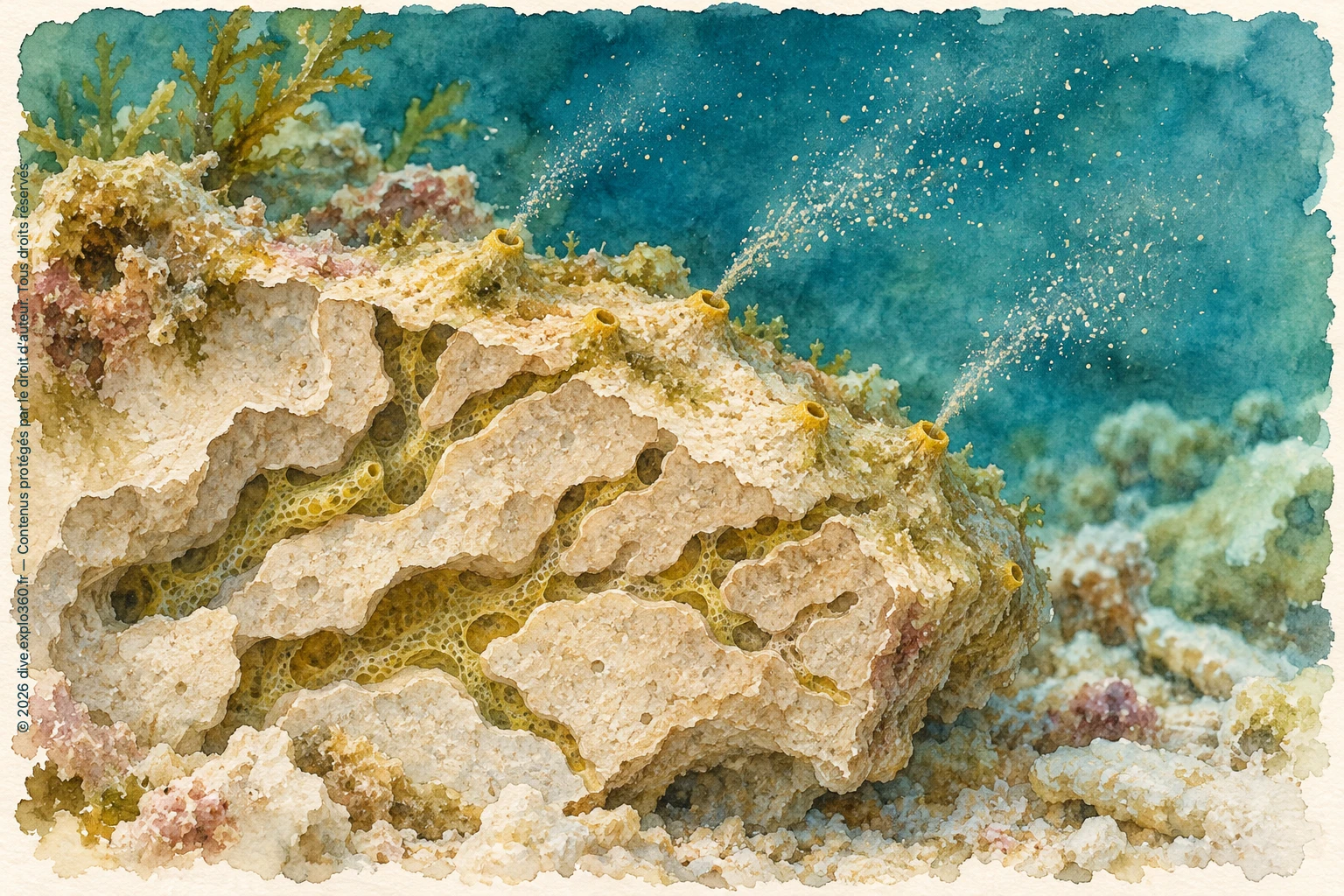
On the surface of an old coral block, a few small coloured openings can go unnoticed. They sometimes belong to a boring sponge. In some species of the Clionaidae family, the bulk of the body develops inside the limestone. Only small openings or papillae remain visible on the surface. A sponge can make space for itself inside the block.
As it grows, it excavates chambers linked by narrow passages. The mechanism combines chemical dissolution of calcium carbonate and removal of tiny mineral fragments. It dissolves carbonate at the surface it is boring into and expels tiny chips. Over time, the cavities grow. Outside, the rock can retain a relatively intact appearance. Inside, part of its structure has already been transformed.
Boring sponges also pump water through a system of internal canals. Depending on the species, they can take up food particles and dissolved material. The sponge draws food from the water even as it changes the shape of the limestone around it. The removal of mineral material by living organisms is called bioerosion.
This is not an accidental destruction. It is a normal biological activity in reef environments, where the construction of calcium carbonate coexists with its dissolution and excavation by various organisms. When conditions change, the balance between these processes can also change.
Construction and erosion happen together
Corals deposit calcium carbonate. Calcareous algae also help strengthen some surfaces. Meanwhile, other organisms break down the mineral framework. Boring sponges excavate chambers. Some polychaete worms bore into limestone. Boring molluscs, including bivalves, can live in cavities they helped excavate. At the surface, parrotfish scrape or bite the substrate as they feed. In some species, this removes limestone.
Bioerosion therefore takes place at several scales. A fish can dislodge a visible amount of material. A sponge can bore into a block for years. Microorganisms break down carbonate at a much smaller scale. These activities have different effects. Some help produce sediment. Others create cavities or weaken the framework locally. Their effects depend on the species, the substrate, and environmental conditions.
On a growing reef, carbonate production can offset losses from biological and physical erosion. If coral growth slows or bioerosion increases, losses can exceed production. A dead colony can lose parts of its internal structure while its outline remains recognisable. This happens too slowly to see on a single dive. Changes become easier to see when researchers compare surveys several years apart.
The tunnels made by boring organisms can in turn provide habitat for other animals.
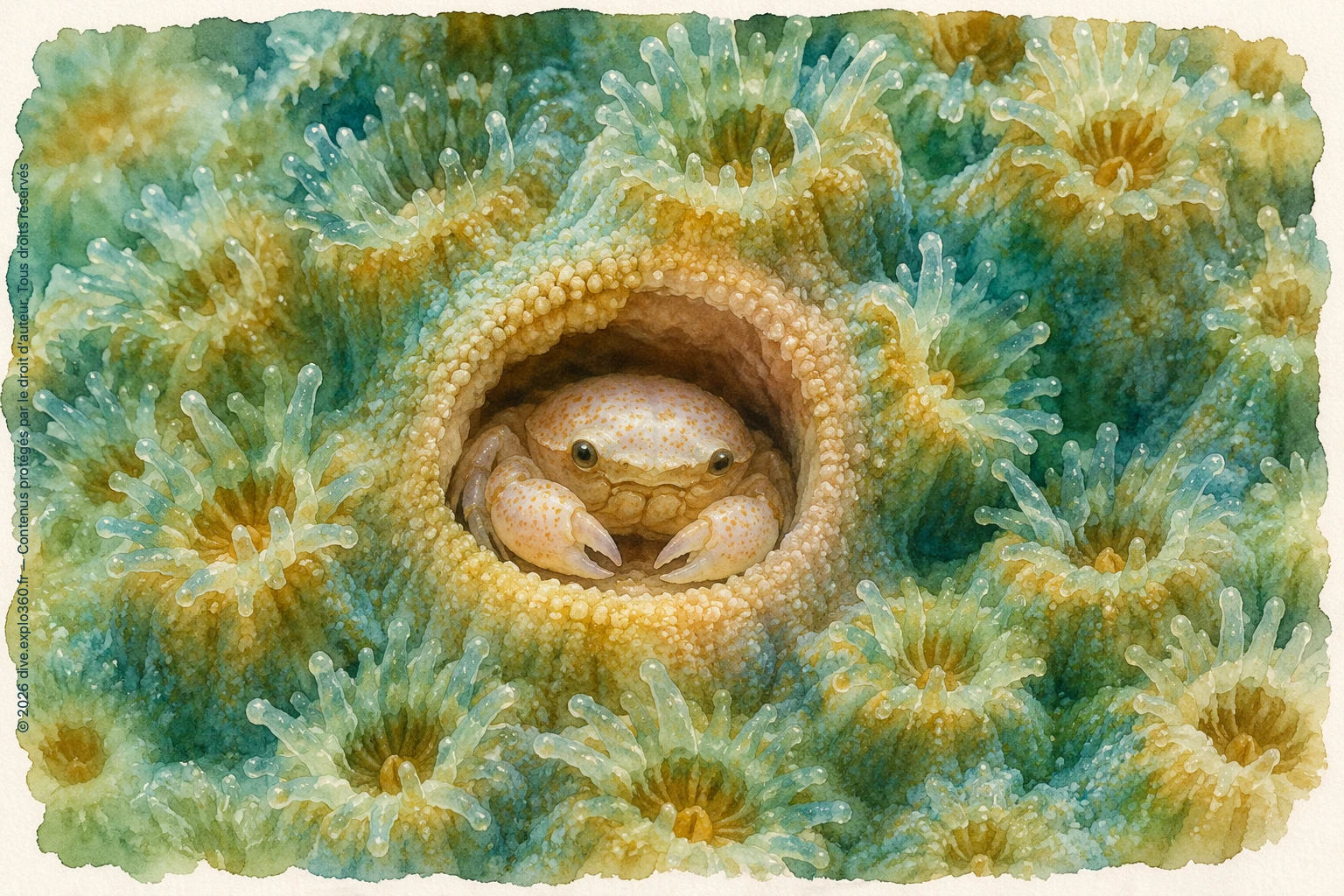
A crab with a home in the coral
Some of the smallest inhabitants of a coral colony are crabs in the family Cryptochiridae. They are tiny, often less than a centimetre long, and live with reef-building corals. Their shelters form within the coral skeleton. Depending on the species, these dwellings take the form of a depression, tunnel or small chamber whose opening remains visible on the surface.
In some crabs, coral growth eventually surrounds the animal almost completely. The adult female then stays in her chamber, while the male, usually smaller, can move between dwellings. The cavity becomes both a shelter and the place where the female continues her reproductive life. These crabs can be closely tied to particular hosts. Some species are known only on a limited number of genera or species of corals.
Their diet is particularly interesting. Analyses of their isotopic composition have shown that several species feed mainly on material from the tissues or mucus of their host coral. This relationship is not necessarily beneficial to both partners, and depending on species and circumstances, feeding on the host may come at a cost to the coral.
The shelters can outlast their occupants by millions of years. The shape of a crab’s shelter can leave a recognisable trace in a fossil coral. Characteristic cavities have been identified in Pliocene and Pleistocene corals, particularly in Florida and the Caribbean. The individual crabs are long gone, but their shelters left traces in the limestone.
A tiny opening on a living coral can be a sign of an association that goes back several million years.
GO FURTHER WITH AMIGANSEAU
Continue reading
Discover full species guides, in-depth content and interactive tools available with your licence.
Dive.Explo360 is an independent, self-funded nonprofit. Every licence helps us create new content, improve our teaching tools and keep some of our resources free and ad-free.
Choose a licence that suits your needs for personal, educational or professional use.
Open-access resources remain available without a subscription.
Scientific references
Explore the same world