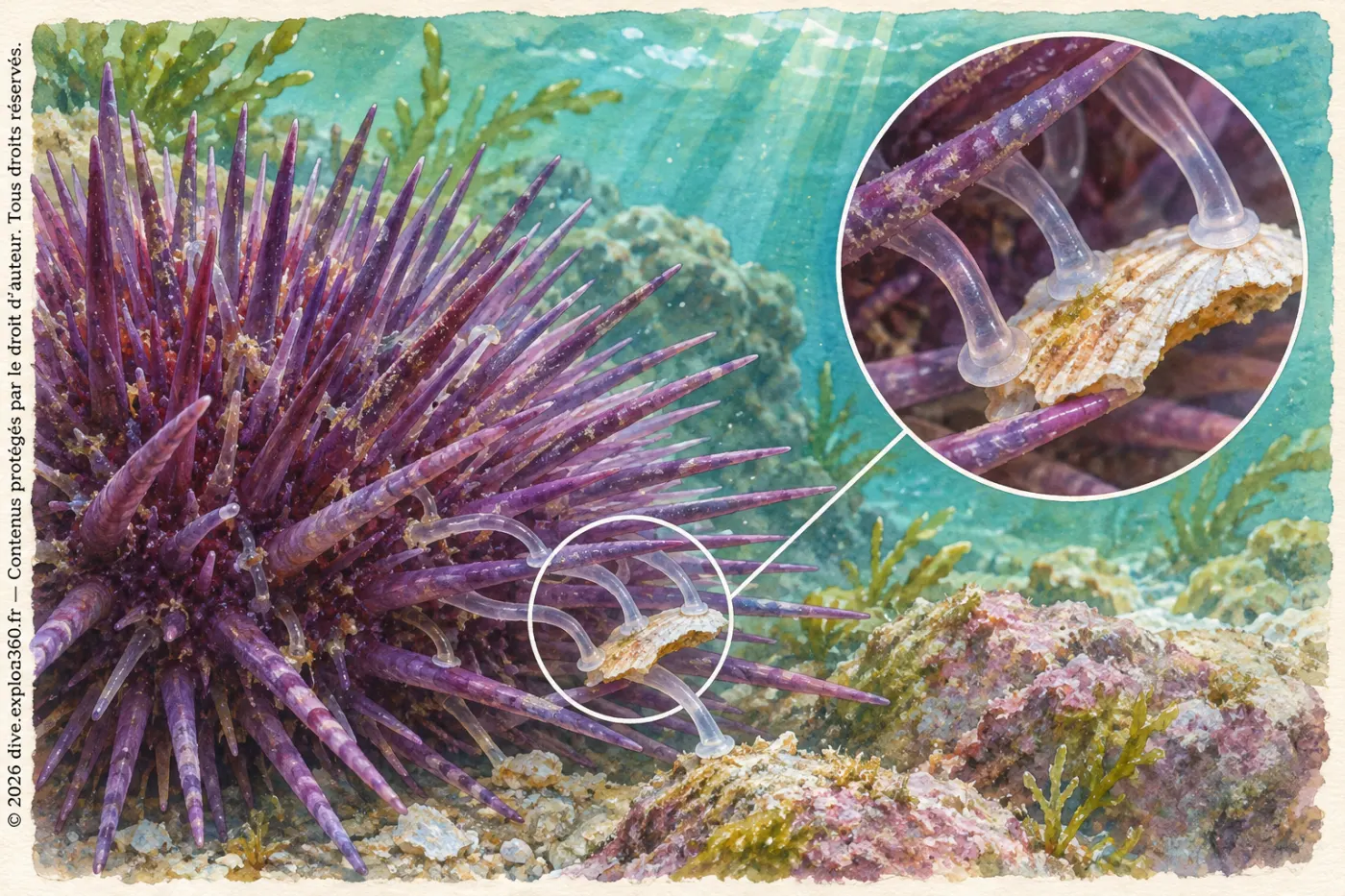
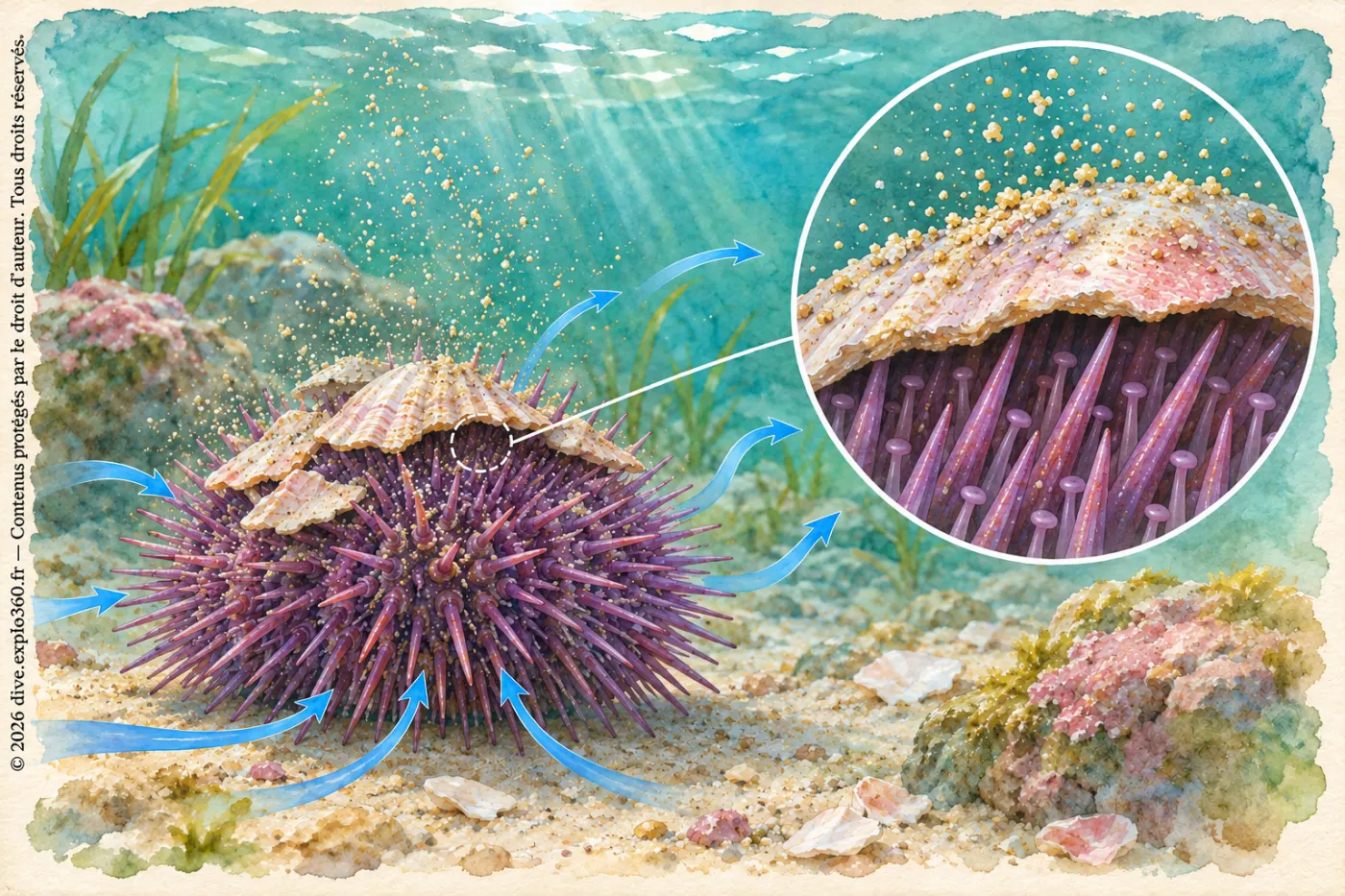
Tube feet pass a fragment with help from the spines. The enlarged inset simplifies the structures and uses a different scale.
Tube feet pass a fragment with help from the spines. The enlarged inset simplifies the structures and uses a different scale. © 2026 dive.explo360.fr — Contenus protégés par le droit d’auteur. Tous droits réservés.

Building a collection, one piece at a time

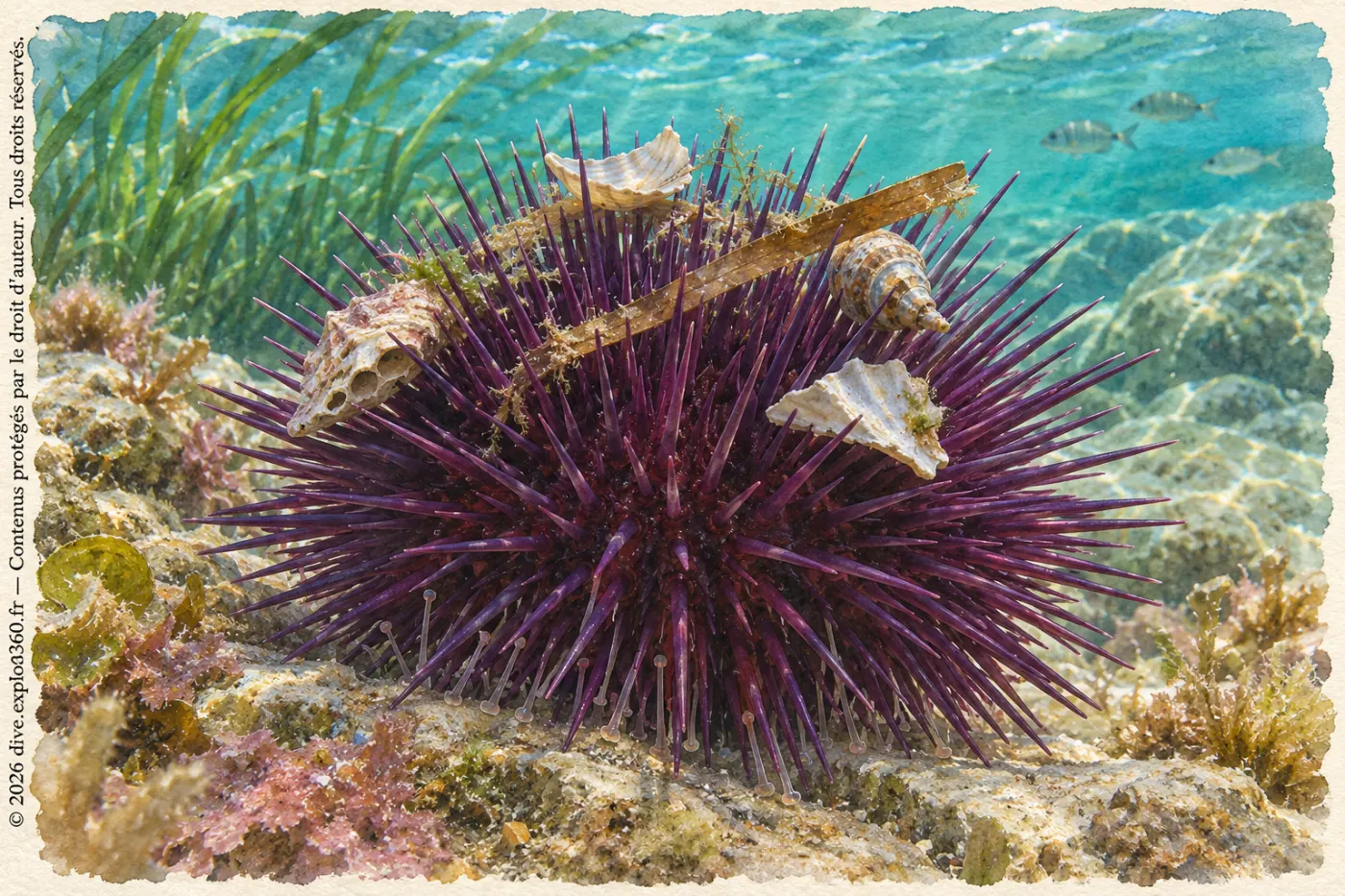
In the purple sea urchin, Paracentrotus lividus, tube feet and spines move fragments onto the upper surface. The water vascular system operates the feet, whose adhesive tips retain material during travel. Pieces are added, moved and discarded as suitable objects are encountered.

Shade from a shell

Light-sensitive cells, including those in tube feet, allow responses to brightness and, in some species, direction. Experiments associate ultraviolet exposure with increased covering. Opaque pieces provide a screen in shallow water, but covering under low light indicates additional influences.
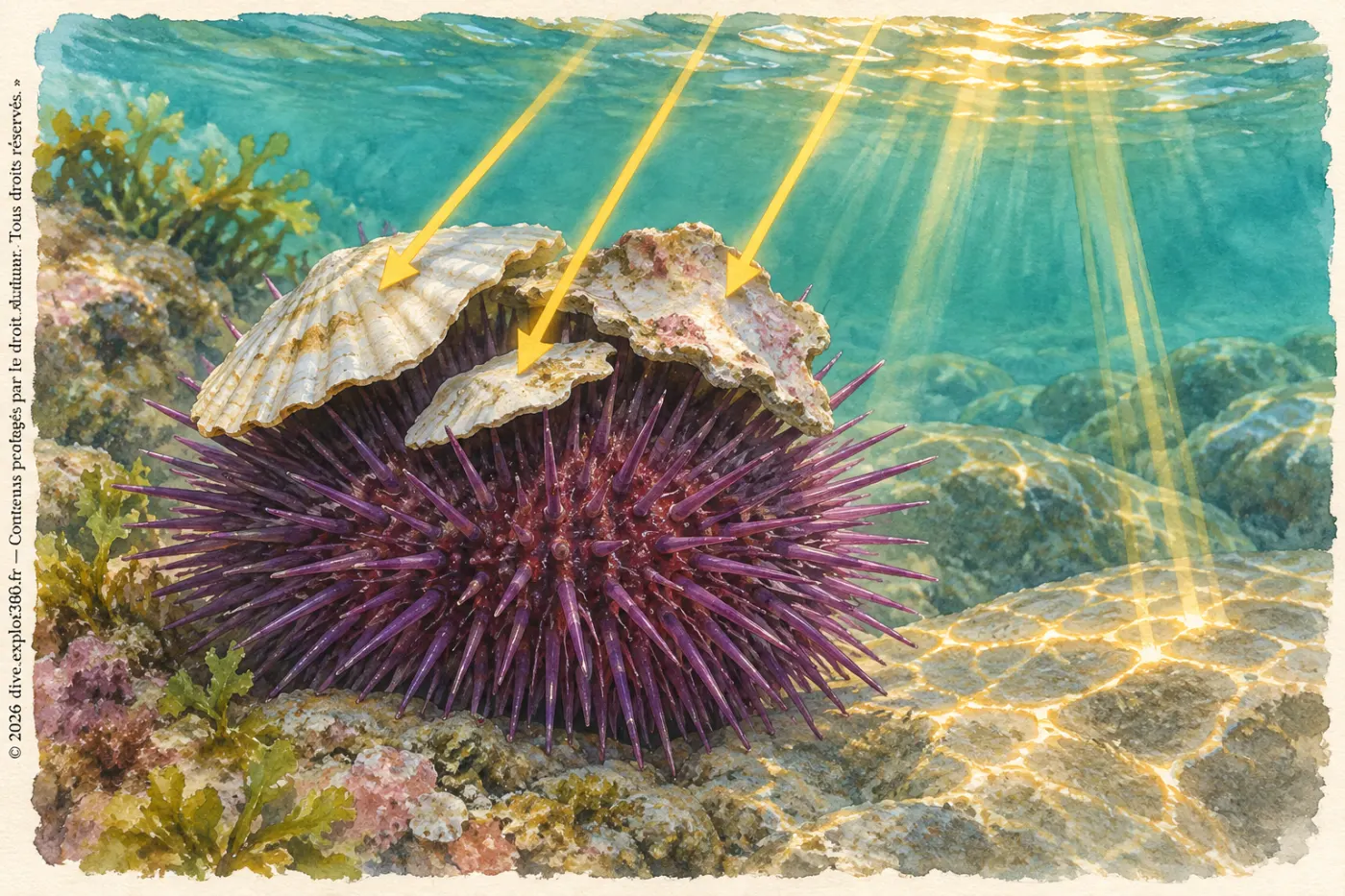
Opaque material intercepts some radiation. Arrows explain the principle; they show neither a measured dose nor a function established for every urchin species.
Opaque material intercepts some radiation. Arrows explain the principle; they show neither a measured dose nor a function established for every urchin species. © 2026 dive.explo360.fr — Contenus protégés par le droit d’auteur. Tous droits réservés.
The umbrella hypothesis proposed by Richner and Milinski: fragments may reduce deposits on the upper body. The enlarged view is explanatory, not an anatomical section.
The umbrella hypothesis proposed by Richner and Milinski: fragments may reduce deposits on the upper body. The enlarged view is explanatory, not an anatomical section. © 2026 dive.explo360.fr — Contenus protégés par le droit d’auteur. Tous droits réservés.

A roof against drifting sand

The Banyuls study published in 2000 measured increased covering in response to suspended sand. The authors proposed that shells shield the upper surface, including the madreporite region associated with the water vascular system. The behavioural result and the suggested protective function are distinct claims.

Choosing the useful pieces

Experiments with Tripneustes gratilla found selection linked to opacity and illumination. Size and mass influence object choice in other urchins too. Such responses can favour useful material without a cognitive understanding of its optical or mechanical properties.
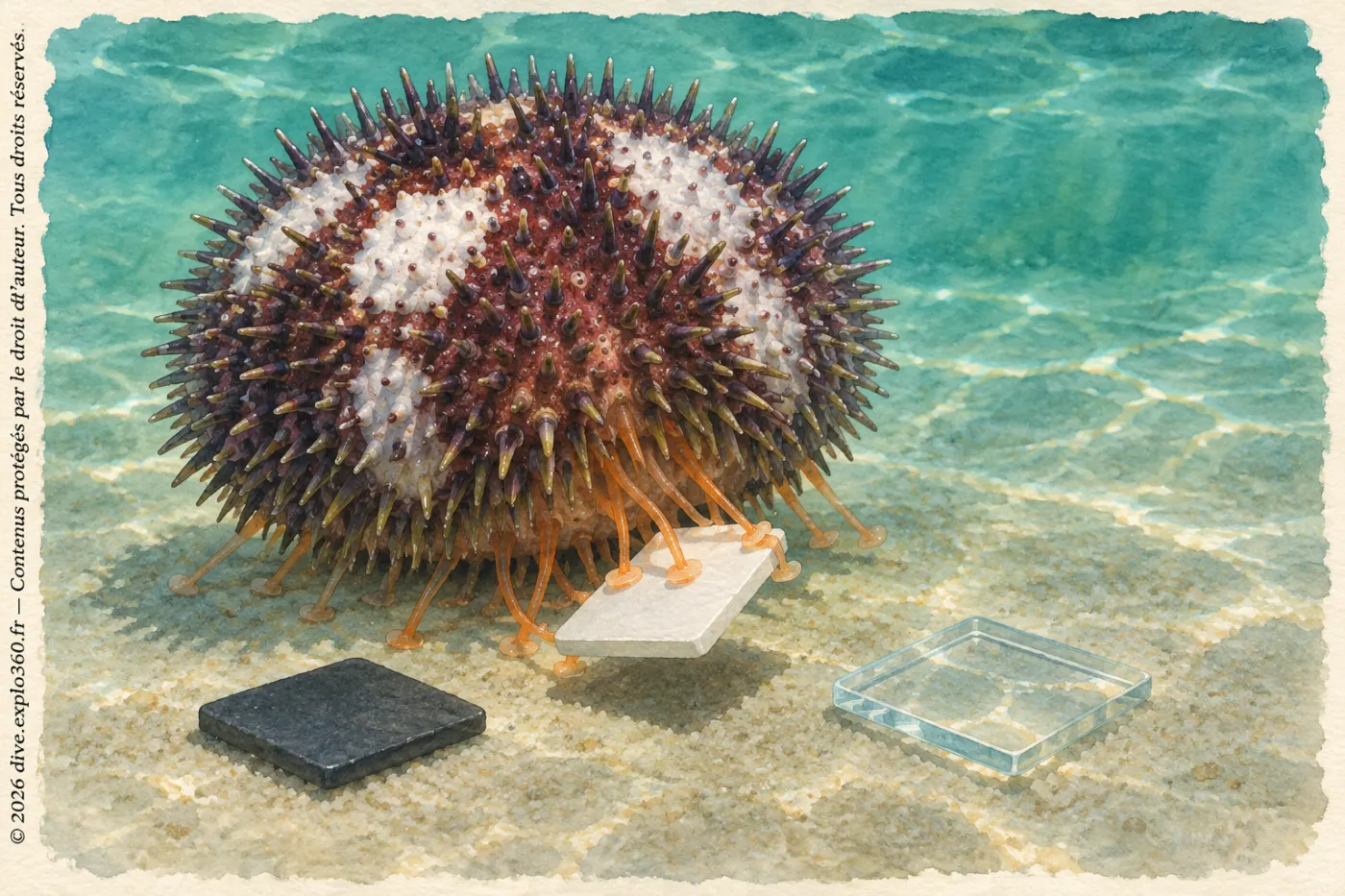
A simplified illustration of Tripneustes gratilla tests, in which opacity and light influenced covering. This is not an exact reconstruction of the apparatus or procedure.
A simplified illustration of Tripneustes gratilla tests, in which opacity and light influenced covering. This is not an exact reconstruction of the apparatus or procedure. © 2026 dive.explo360.fr — Contenus protégés par le droit d’auteur. Tous droits réservés.
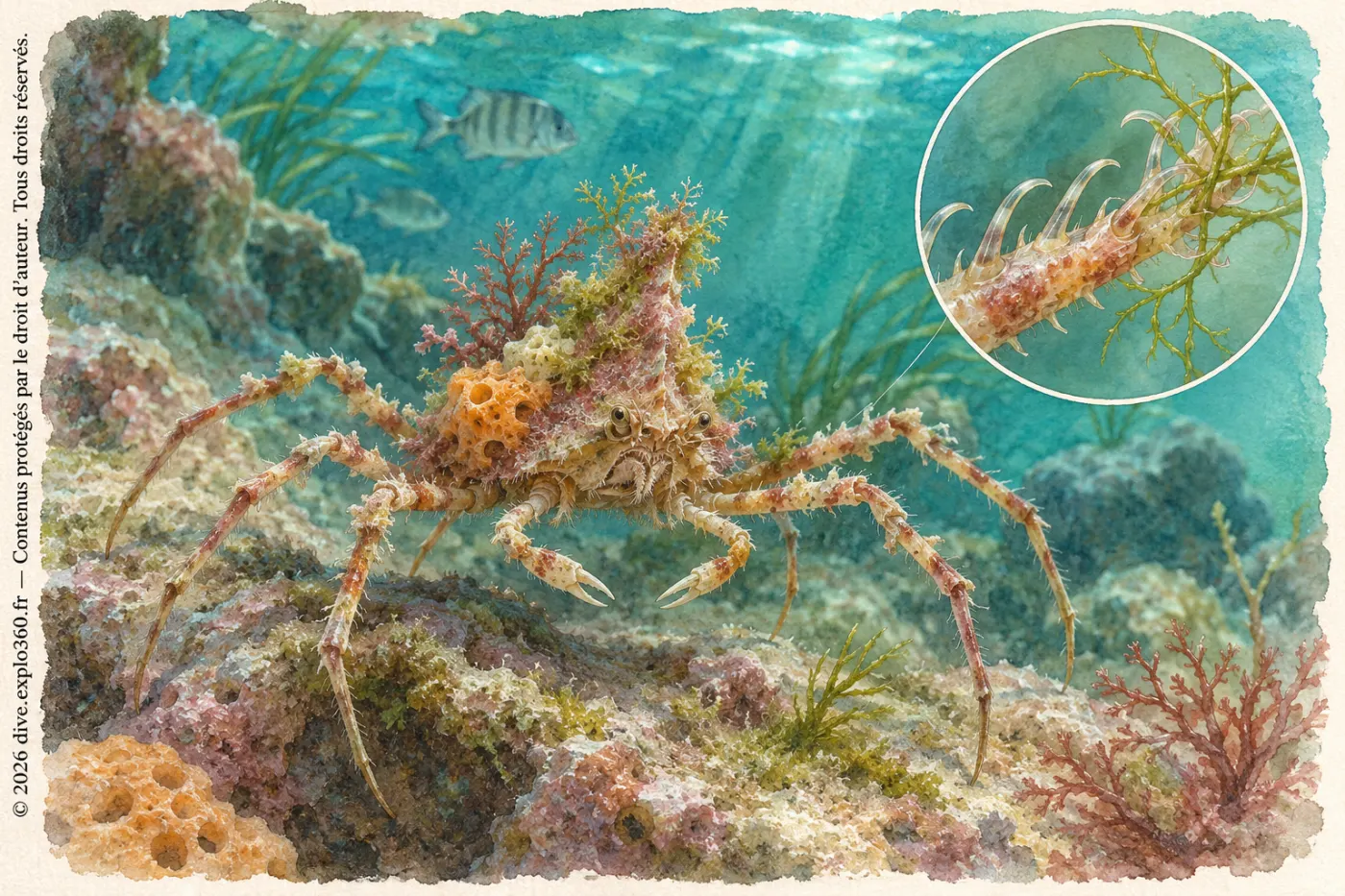
Inachus phalangium decorated with algae and sponges. Hooked bristles are shown separately at an enlarged scale.
Inachus phalangium decorated with algae and sponges. Hooked bristles are shown separately at an enlarged scale. © 2026 dive.explo360.fr — Contenus protégés par le droit d’auteur. Tous droits réservés.

A walking disguise

Several majoid crabs prepare algae, sponges or hydroids with claws and mouthparts and secure them on hooked bristles called setae. Attachment allows retention without continual gripping, unlike an urchin’s covering. The crab can walk and feed while carrying its disguise.

Borrowing an alga’s defences

Stachowicz and Hay distinguished decoration from dietary choice in Libinia dubia. Juveniles carrying chemically defended Dictyota menstrualis suffered less predation than crabs wearing another alga. Large adults beyond the main local fish predators’ size range stopped decorating. Materials also varied geographically where Dictyota was absent.
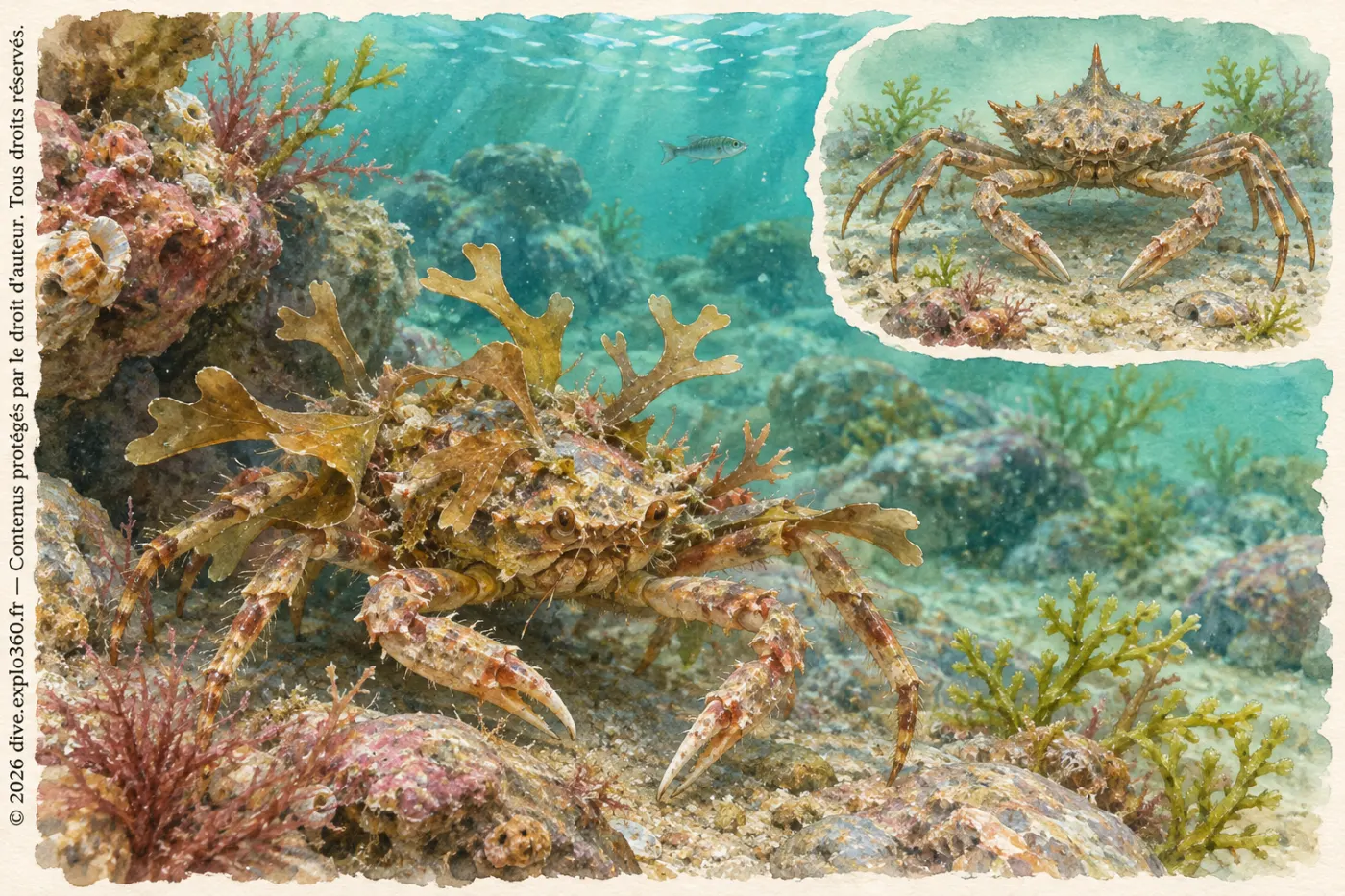
Libinia dubia with Dictyota menstrualis. The views use different scales. Experiments distinguished material chosen for decoration from food preferences and effects on survival.
Libinia dubia with Dictyota menstrualis. The views use different scales. Experiments distinguished material chosen for decoration from food preferences and effects on survival. © 2026 dive.explo360.fr — Contenus protégés par le droit d’auteur. Tous droits réservés.

GO FURTHER WITH AMIGANSEAU

Continue reading

Discover full species guides, in-depth content and interactive tools available with your licence.

Your subscription helps preserve our independence.

Dive.Explo360 is an independent, self-funded nonprofit. Every licence helps us create new content, improve our teaching tools and keep some of our resources free and ad-free.

Licences from €80 per year

Choose a licence that suits your needs for personal, educational or professional use.

Open-access resources remain available without a subscription.

Scientific references

Richner, H. & Milinski, M. (2000). On the functional significance of masking behaviour in sea urchins — an experiment with Paracentrotus lividus. Marine Ecology Progress Series, 205, 307–308doi.orgSigg, J. E., Lloyd-Knight, K. M. & Boal, J. G. (2007). UV radiation influences covering behaviour in the urchin Lytechinus variegatus. Journal of the Marine Biological Association of the United Kingdom, 87, 1257–1261doi.orgZiegenhorn, M. A. (2016). Best Dressed Test: A Study of the Covering Behavior of the Collector Urchin Tripneustes gratilla (2016)pmc.ncbi.nlm.nih.govTool Use by Four Species of Indo-Pacific Sea Urchins (2019). Journal of Marine Science and Engineering, 7, 69doi.orgDrivers and functional consequences of covering in a pervasive marine grazer (green sea urchin, Strongylocentrotus droebachiensis) (2026)doi.orgUse of sponges in the decoration of Inachus phalangium (Decapoda, Majidae) from the Adriatic Sea (2006)doi.orgStachowicz, J. J. & Hay, M. E. (1999). Reducing predation through chemically mediated camouflage: indirect effects of plant defenses on herbivores. Ecology, 80, 495–509doi.orgStachowicz, J. J. & Hay, M. E. (2000). Geographic Variation in Camouflage Specialization by a Decorator Crab. The American Naturalist, 156, 59–71doi.orgThe evolutionary ecology of decorating behaviour (2015)pmc.ncbi.nlm.nih.govFinn, J. K., Tregenza, T. & Norman, M. D. (2009). Defensive tool use in a coconut-carrying octopus. Current Biology, 19, R1069–R1070doi.orgMann, J. & Patterson, E. M. (2013). Tool use by aquatic animals. Philosophical Transactions of the Royal Society Bpmc.ncbi.nlm.nih.govHow intelligent is a cephalopod? Lessons from comparative cognition (2021). Biological Reviewsdoi.orgRoss, D. M. (1971). Protection of hermit crabs (Dardanus spp.) from octopus by commensal sea anemones (Calliactis spp.). Nature, 230, 401–402doi.orgHarada, K., Hayashi, N. & Kagaya, K. (2020). Individual behavioral type captured by a Bayesian model comparison of cap making by sponge crabs. PeerJ, 8, e9036doi.orgEffects of shell condition and size upon the shell choice behavior of a hermit crab (1985). Journal of Experimental Marine Biology and Ecology, 88, 271–285doi.orgZhu Min-Da (1984). Le phénomène d’agglutination dans le genre Xenophora. Nouvelles archives du Muséum d’histoire naturelle de Lyon, 22, 3–50www.persee.frKrützen, M. et al. (2005). Cultural transmission of tool use in bottlenose dolphins. PNAS, 102, 8939–8943doi.org