


AQUA MEMORA
Recognise species from videos.
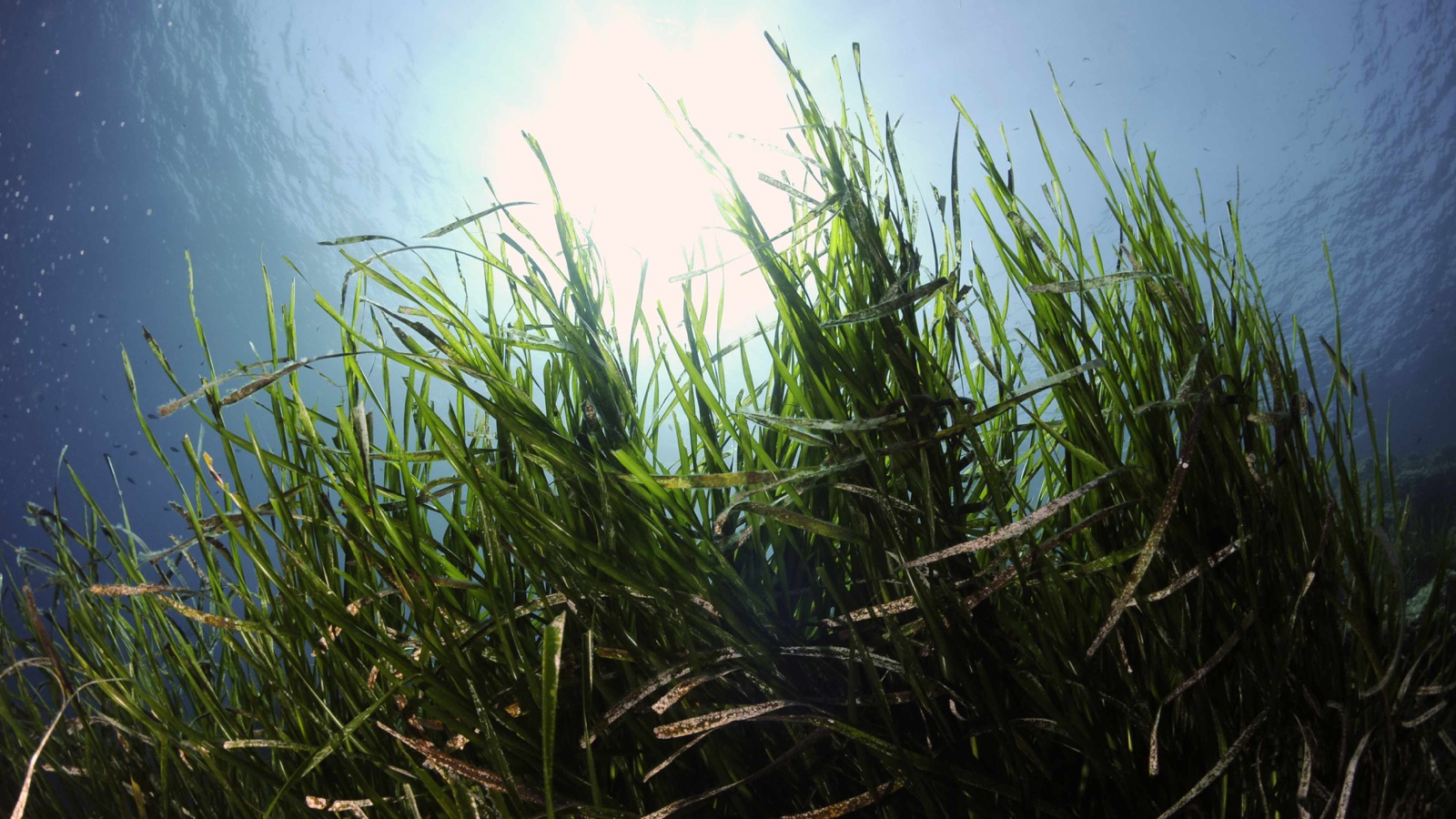
Starting with authentic underwater observations, Dive.Explo360 connects footage, species, habitats and knowledge to offer different ways to learn, from the Mediterranean to other seas gradually being explored.
The Mediterranean, particularly the Hyères islands, remains the best documented foundation. Observations from the Red Sea, the Maldives and Raja Ampat are gradually enriching the collection. Available tools, content and translations vary by region and device; the current learning paths remain Mediterranean.
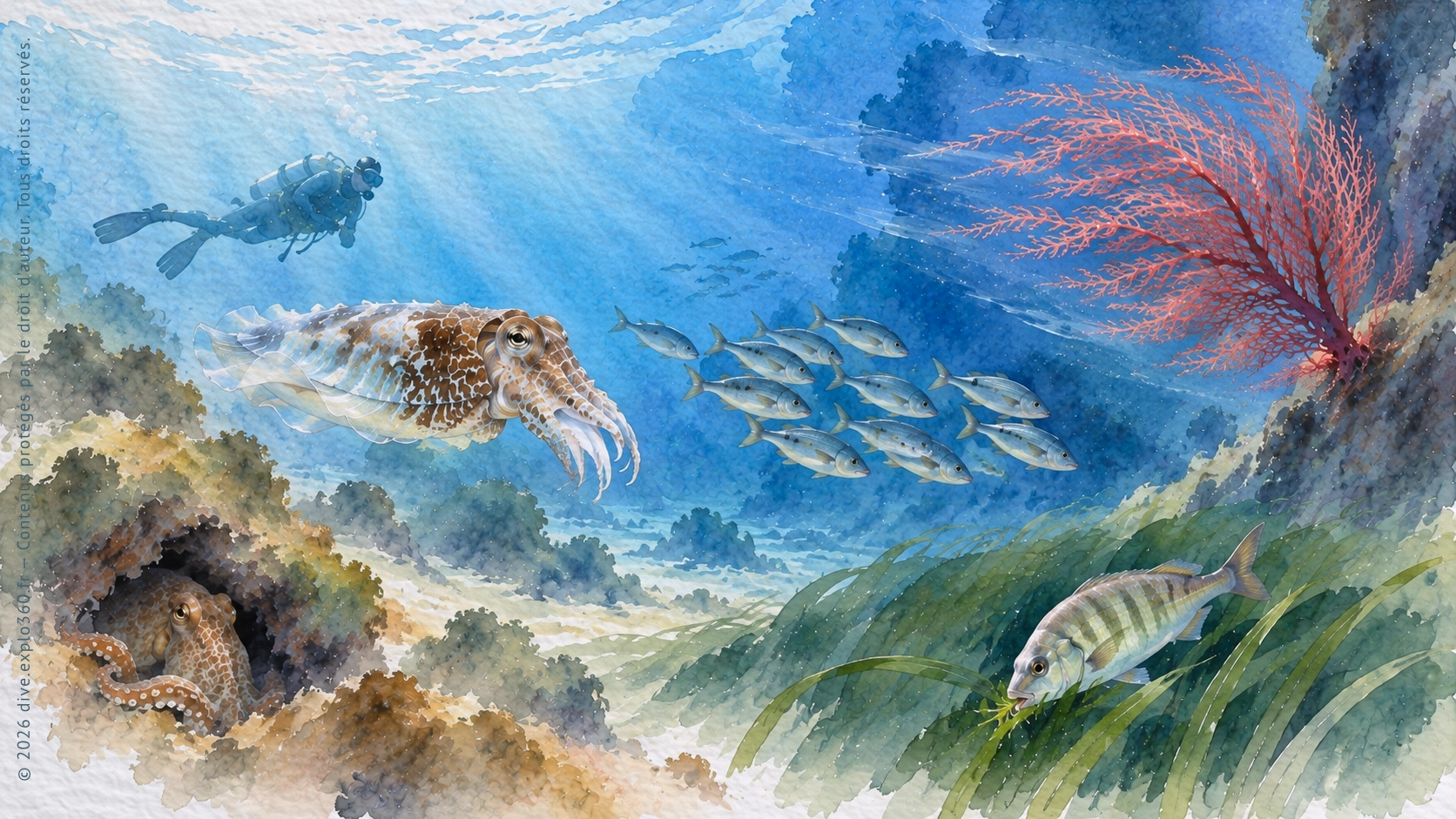
Visitors do not discover a species in isolation: they see it in its habitat, moving and in its real context.
These scenes become the starting point for learning.
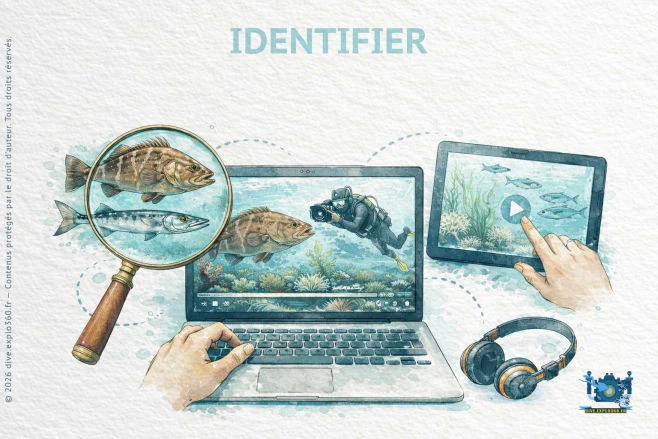
When an organism appears in a video, clic-M.O.I lets you identify it and instantly open its summary profile, adapted to the selected reading level. You can then return to the dive and continue observing.
At the end of each dive, a dedicated quiz lets you revisit the species you encountered and reinforce what you learnt during your exploration.
Identification becomes a gateway to all of Dive.Explo360.
Explore the dives
Dive.Explo360 offers several ways to access species: from a dive with clic-M.O.I, through a direct search, or by exploring biodiversity by depth, habitat or phylum.
Each guide introduces a species. Available chapters depend on the reading level and access permissions:
What does it look like? · Where does it live? · What does it eat?
It also places the species in its ecological context : biological group, food web and the way its natural environment works.
The content adapts to the selected reading level. With a licence, the full profile provides access to more detailed knowledge of marine life.
Identify a species, find it in another way, then understand its place in its environment.
Discover the profilesdis-MOI finds answers in a structured natural history corpus that has been prepared and checked. During a search, it does not ask generative AI to invent an answer. Despite our checks, errors remain possible.
Ask a question, explore a topic or let dis-MOI suggest a discovery. The site’s region and reading level guide the answers; their language depends on published translations. General knowledge may apply to several seas, while local observations remain tied to their region.
Curiosity becomes a way to navigate.
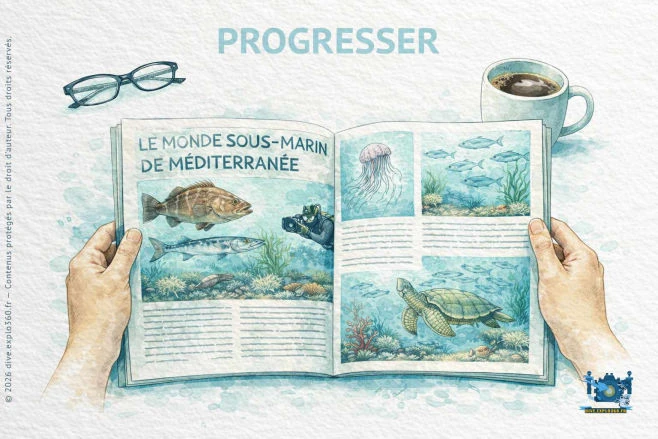
Articles let you start from an observation and understand the phenomena behind it : behaviour, perception, camouflage, shoaling, anatomy, feeding, habitats and how ecosystems function.
Each topic connects with other Dive.Explo360 content: species, dives, habitats, learning paths and related articles.
The same topic can be discovered at different levels, then explored further by moving naturally from one resource to another.
Read the articles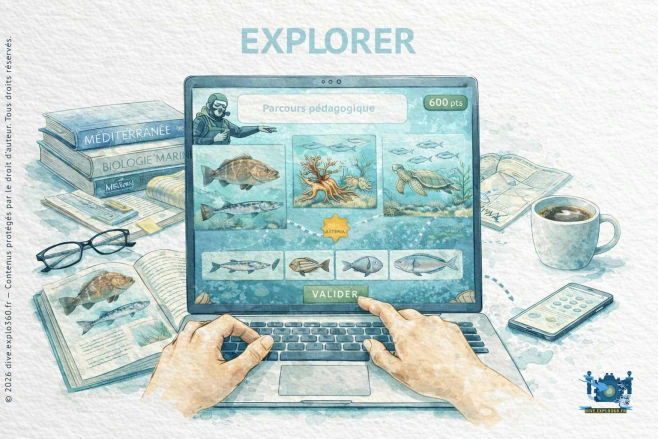
Learning paths offer a guided exploration of a topic. They connect observations, species, explanations and interactions, helping you progress step by step and understand the connections that shape Mediterranean marine life.
Four Mediterranean learning paths are currently available:
Posidonia meadow · Coralligenous habitat · Maerl and sand · Wrecks
Further learning paths will gradually introduce new marine topics, phenomena and observations as resources are published.
Each learning path adapts its content and explanations to the selected reading level.
Explore the learning pathsThe games use the same species, habitats and knowledge.
Recognise species from videos.
Understand the major groups of living organisms.
Match species to habitats.
Discover ecological roles.
Learn while staying within the world you have just explored.
Dive.Explo360 is not only experienced on the web. The same learning environment can be brought into physical installations adapted to venues, audiences and uses.
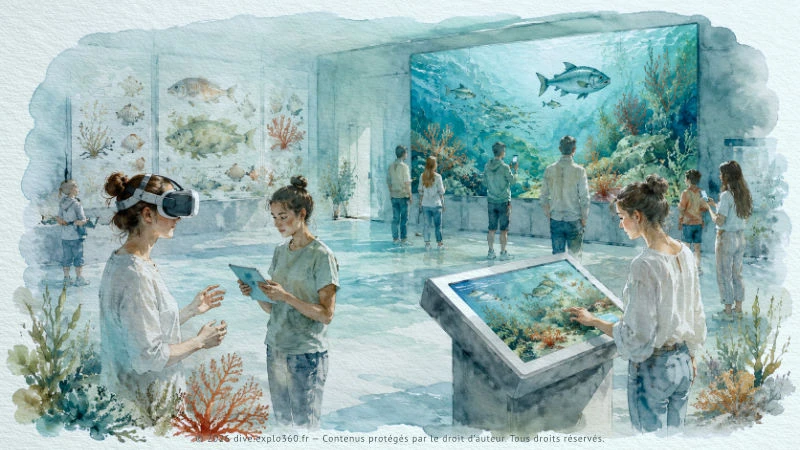
On a large screen, discovery becomes a shared experience. On a touchscreen kiosk, everyone explores and chooses freely. With an immersive headset, users enter real diving footage and can be guided in their observations.
The same content, three experiences: watching, touching, immersion.

Shared viewing on a large screen and individual interaction on a smartphone.

A touchscreen interface to freely discover Dive.Explo360 content.

View, spot details and ask questions about real underwater scenes with a guide.
After a dive, Explorarium lets you revisit and describe your underwater experience : the site, the conditions, the atmosphere, the species observed and your own memories.
Dive after dive, you build a personal record of your explorations, which you can enrich with observations of marine life to better understand the landscapes and encounters you have just experienced.
Remember your dives, revisit your observations and learn to see things differently on your next underwater adventure.
Discover ExplorariumAn educator prepares and runs a session using videos, profiles, articles, learning paths, games, dis-MOI questions, teaching materials and documents for students.
Before the session. During the activity. Afterwards.
Real dives, TV and immersive experiences provide a shared scene for the group.
Several depths of explanation are available for ages 6–10, 11–14, 15–17 and adults.
Questions, identification, games and touchscreen kiosks get the audience actively involved.
Student documents, the log and related resources structure follow-up work after the session.
The content stays the same. What changes is the way you experience it.
Part of Dive.Explo360 is available free of charge for personal discovery. Licences extend its uses to teaching, educational outreach, touchscreen kiosks, shared screenings, institutions, local authorities and professional tools.
During its testing period, the full version of dis-MOI is available free of charge to all visitors. Visitors can search for a question, explore topics and consult answers available for their selected region and language.
After this testing phase, access to some dis-MOI functions may depend on the licence used.
Discover licencesThe platform does not give everyone the same level of explanation. The same observation leads to different depths of understanding within the same marine world.
The content is designed for ages 6–10, 11–14 and 15–17, curious adults, divers, teachers and educators.
Dive.Explo360 brings together real dives, the species profiles, the articles, the learning path, the games, an observation log and the search engine dis-MOI.
Yes, with a licence suited to the intended use. Dive.Explo360 can be used with a class, a group of divers, during training, in a workshop or at a public venue. AMIGANSEAU licences define the permitted uses according to the setting: teaching, educational outreach, associations, professional organisations or public screenings.
Dive.Explo360 lets you look, recognise, ask questions, search, compare, play and record an observation. And, almost without noticing, learn.
Understanding inspires a different way of looking.