
Observe with Dive.Explo360
Red Sea marine life: observe, identify and understand
Two white bands, an anemone and coral shapes nearby: a short scene can open up a whole exploration. Start with footage from our Red Sea dives, identify what you see and connect these organisms to their environment.
Start with a filmed observation
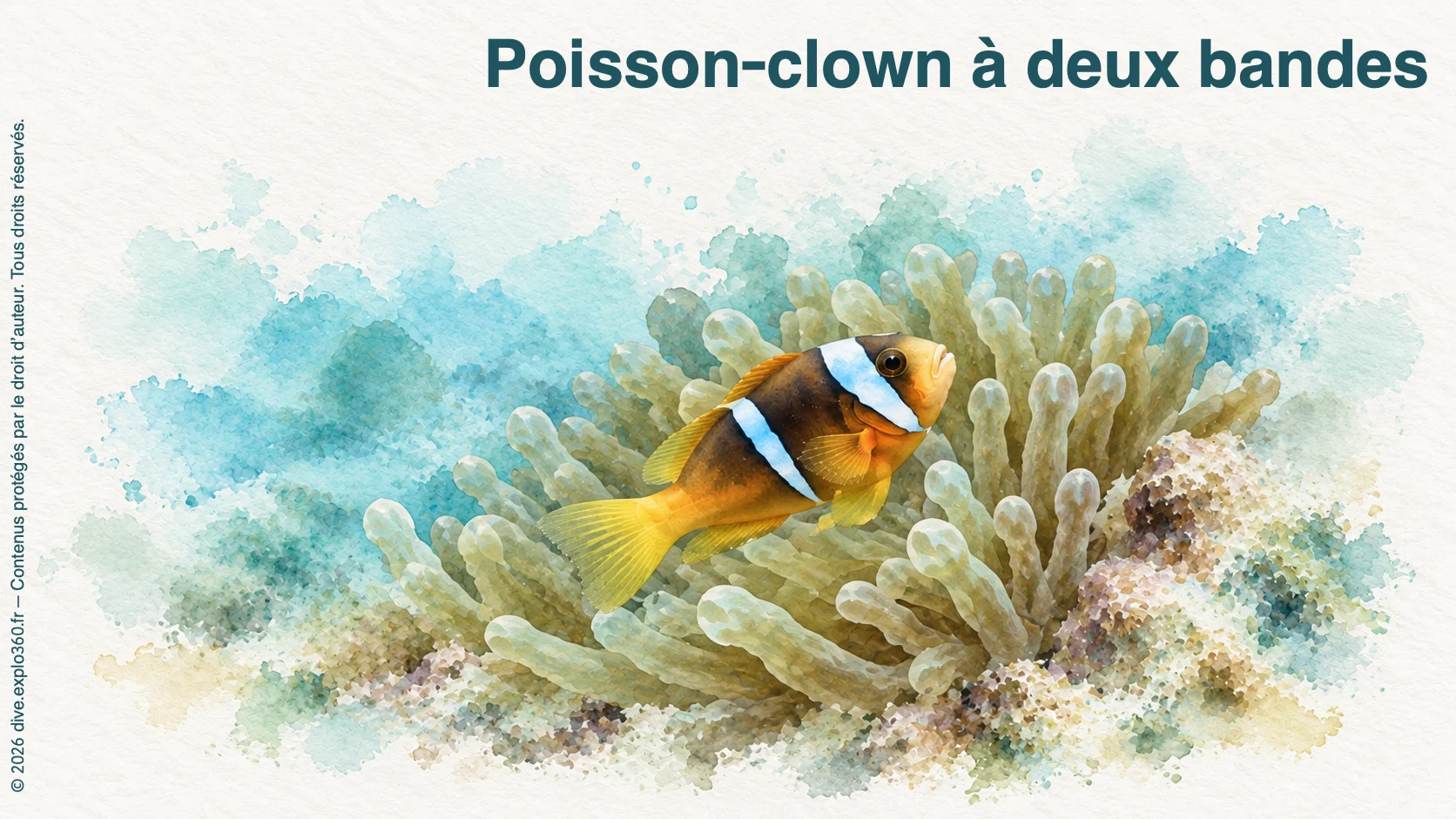
In Coral Garden, the segment from 10.36 to 13.60 seconds shows a two-band anemonefish among an anemone’s tentacles. Look first at the fish, then at its surroundings: identification also includes organisms attached to the seabed.
© dive.explo360.fr — Tous droits réservés. Reproduction interdite sans autorisation.
Dives that connect you to observations
Three films offer sequences linked to species profiles. Coral Garden includes the two-band anemonefish and Acropora corals; Merry Christmas Bubbles includes the emperor angelfish; A Dark Night in the Red Sea includes giant clams. Open a dive and select an organism in its Clic-MOI sequences.
Identify organisms actually filmed
These four examples take you from a recognisable fish to a coral or a mollusc. Each dive link corresponds to an organism recorded in that film’s segments.
- Identify Two-band anemonefish: open the species profile
Observe Two-band anemonefish in CORAL GARDEN - Identify Acropora corals: open the species profile
Observe Acropora corals in CORAL GARDEN - Identify Emperor angelfish: open the species profile
Observe Emperor angelfish in MERRY CHRISTMAS BUBBLES - Identify Red Sea giant clams: open the species profile
Observe Red Sea giant clams in A DARK NIGHT IN THE RED SEA
From observed organisms to their environment
In the anemonefish scene, anemone tentacles are visible in the foreground, with coral formations around them. This observed proximity is a starting point for understanding relationships among reef inhabitants. The species profile and article provide the biological explanation; the short sequence provides a concrete observation.
These examples come from Dive.Explo360 films; they are not an inventory of the whole region. Depth ranges and habitats described in a species profile refer to the organism, not to the specific filming conditions.
Learn with Dive.Explo360 resources
A name is a starting point. In The secrets of coral reefs, discover how tiny animals build a reef and how its inhabitants depend on one another. Then explore the chosen organism through species profiles at four reading levels: primary school, middle school, high school and non-specialist adults.
Continue your exploration
Start with what you noticed: body shape, colours and position in the water can guide your search. Use the existing routes by habitat, position in the environment, biological group or ecological role, then return to the video to compare your identification with the images.