

SEE THE BIGGER PICTURE · Adults (18+)
Crustaceans
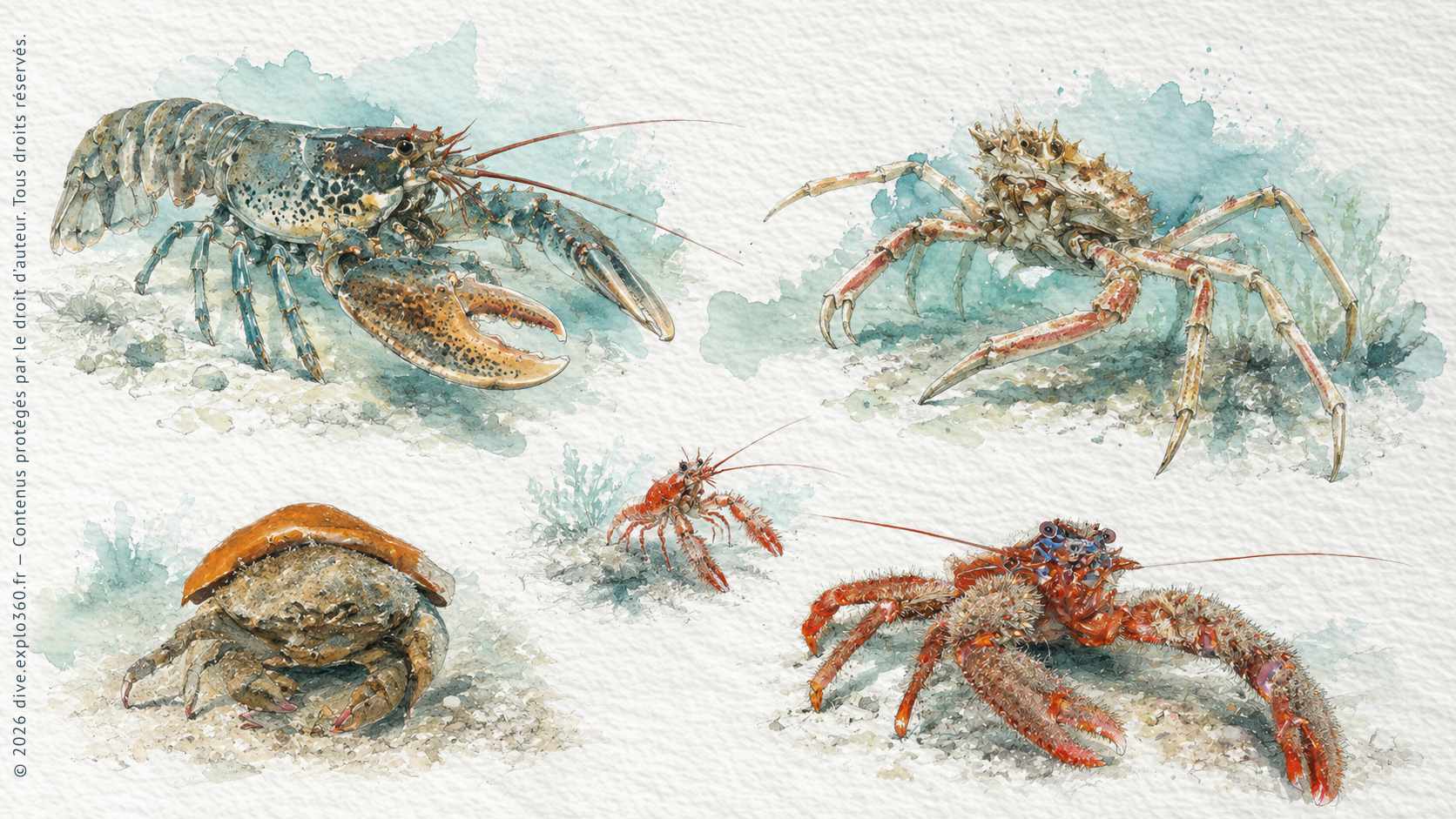
Crabs, shrimps, lobsters, barnacles and many small planktonic organisms are crustaceans. Their ways of life vary: some walk on the seabed, others swim, drift or remain attached.
Recognising their organisation
The body has jointed appendages and an external skeleton. To grow, the animal replaces this covering during moulting. Legs, antennae and mouthparts are adapted to different functions depending on the species.
A place in the living environment
Crustaceans may capture prey, consume remains, graze or filter particles. In turn, they feed fish, molluscs and other predators. Small planktonic crustaceans notably connect microscopic resources with larger consumers.
Exploring further
Crustaceans belong to the arthropods. Their exoskeleton and jointed appendages are associated with discontinuous growth through moulting. Larval and adult stages may occupy different habitats and trophic positions; the role of an adult crab therefore does not describe that of all crustaceans.
Key points
Crustaceans may capture prey, consume remains, graze or filter particles. In turn, they feed fish, molluscs and other predators. Small planktonic crustaceans notably connect microscopic resources with larger consumers.