

SEE THE BIGGER PICTURE · Adults (18+)
Tunicates
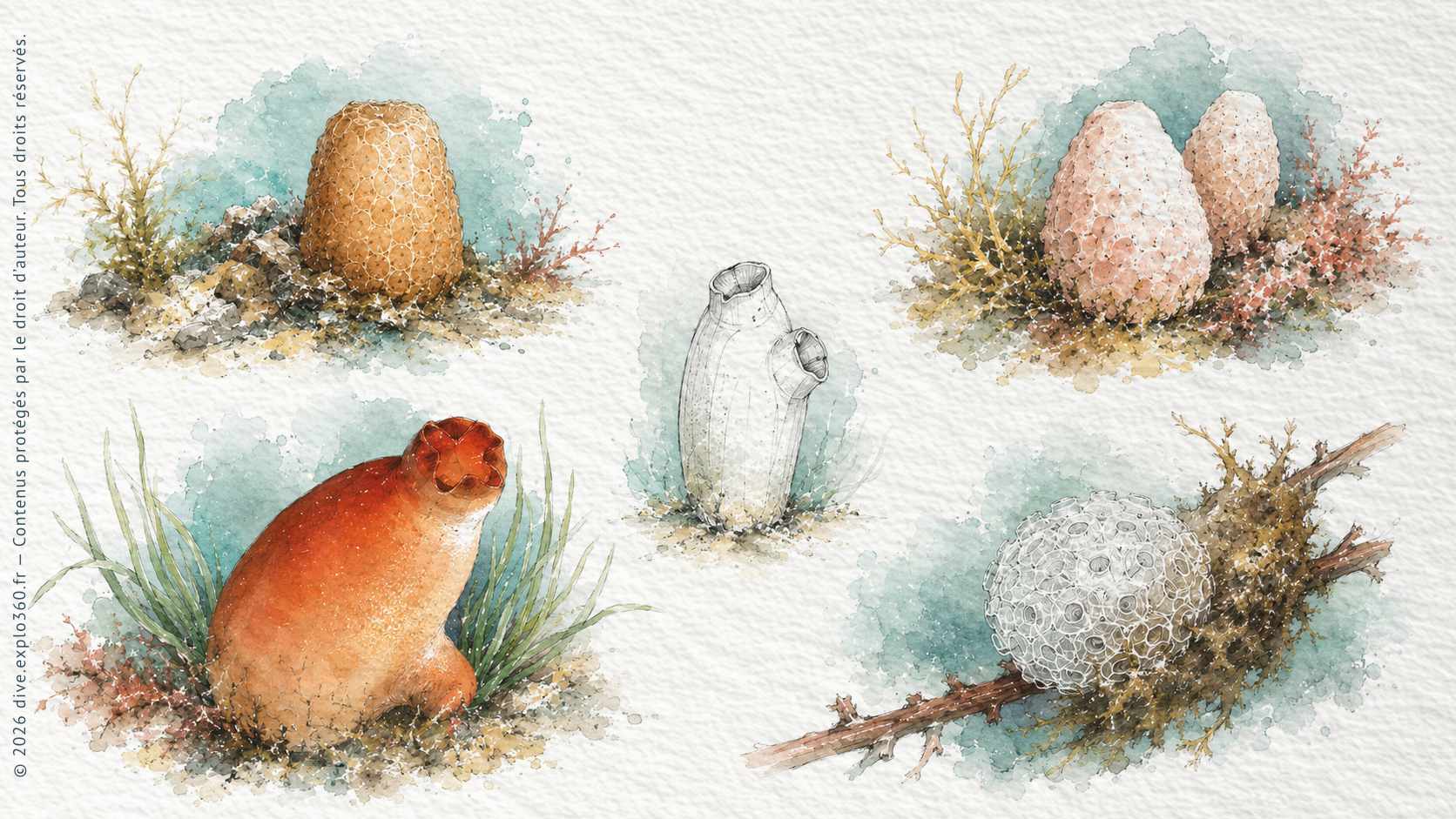
Tunicates are marine animals protected by a covering called a tunic. Sea squirts, often seen attached to the bottom, live alone or in colonies. Other tunicates, such as salps, live in open water.
Recognising their organisation
In an adult sea squirt, water enters through one siphon, passes through a filtering apparatus and leaves through another siphon. Fine particles are retained to feed the animal. The siphons are therefore not two mouths.
A place in the living environment
Filter-feeding tunicates transfer resources from the water into their own biomass. Attached forms contribute to substrate communities, while pelagic forms participate in open-water food webs. Their appearance and ways of life are very varied.
Exploring further
Tunicates belong to the chordates. The typical swimming larva of many sea squirts has a notochord in its tail; it then metamorphoses into an attached adult. A perforated pharynx and a mucus-trapping system contribute to filtration. The sea squirt life cycle should not be applied without qualification to all tunicates.
Key points
Filter-feeding tunicates transfer resources from the water into their own biomass. Attached forms contribute to substrate communities, while pelagic forms participate in open-water food webs. Their appearance and ways of life are very varied.