

SEE THE BIGGER PICTURE · Adults (18+)
Echinoderms
Starfish, sea urchins, brittle stars, sea cucumbers and crinoids belong to the echinoderms. They are exclusively marine animals. They mainly live in association with the seabed and have very different shapes.
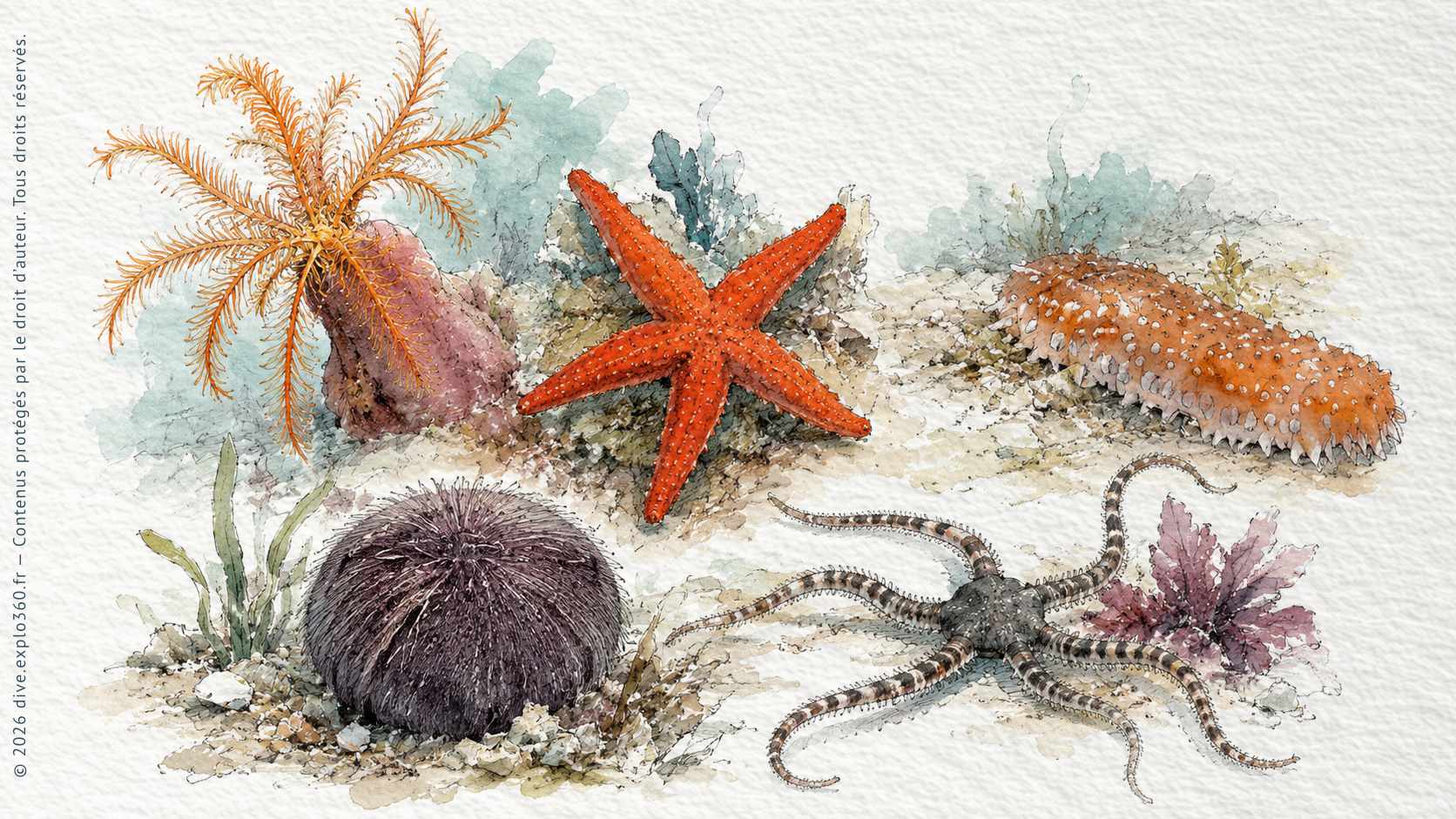
Recognising their organisation
The adult body is often organised in five directions, although this is less visible in sea cucumbers. A system of fluid-filled canals operates small feet, called podia, that contribute notably to movement or attachment.
A place in the living environment
Some sea urchins graze, some starfish capture prey, many sea cucumbers consume deposits and crinoids capture suspended particles. These activities influence seabed communities. None of these diets should automatically be attributed to every species in the group.
Exploring further
The adult's frequent five-fold radial symmetry contrasts with the bilateral symmetry of larvae. A water vascular system and calcium carbonate endoskeleton are characteristic. Regeneration occurs to varying degrees: it does not mean that any isolated part can regrow into a whole animal.
Key points
Some sea urchins graze, some starfish capture prey, many sea cucumbers consume deposits and crinoids capture suspended particles. These activities influence seabed communities. None of these diets should automatically be attributed to every species in the group.