

SEE THE BIGGER PICTURE · Adults (18+)
The ecological engine of an underwater biotope
What makes an underwater environment work? Water and seabed conditions, organisms that produce living matter, those that consume it and those that decompose it act together. The 'ecological engine' refers to these interactions, not to a perfectly regulated machine.
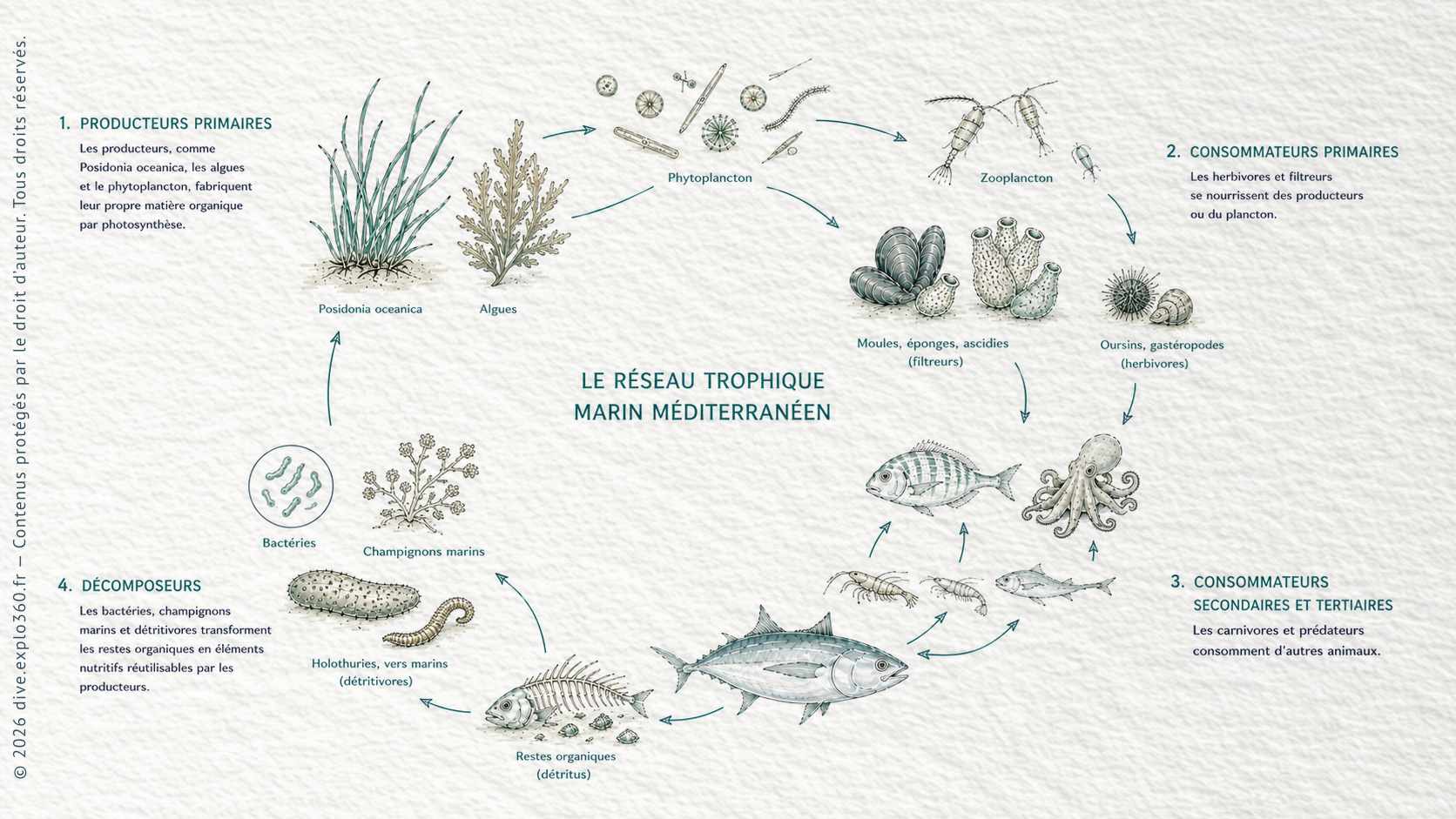
The environment sets the starting conditions
Available light depends on depth and water clarity. Temperature, dissolved salt, oxygen and water movement influence living things. Currents renew water and carry food, larvae and nutrients—the elements needed for growth.
The seabed matters too: rock, sand and artificial surfaces offer different opportunities for attachment, burrowing and shelter. These physical and chemical conditions constitute the biotope. The living community is the biocoenosis; together, with their interactions, they form the ecosystem.
Producing the matter that feeds life
Where there is enough light, marine plants, algae and many phytoplankton organisms make organic matter through photosynthesis. They use light energy, inorganic carbon and nutrients. They are primary producers, at the start of many feeding pathways.
The producers present vary between places. Production may happen locally or elsewhere: a community may receive food carried by currents or sinking from upper water layers.
Consumers with many ways of feeding
Herbivores and predators consume other organisms. Filter feeders, such as some sponges and mussels, capture fine particles from the water. Depending on the species, these particles include microscopic organisms or debris. Filtering therefore does not always mean eating only producers.
Feeding relationships form a web with several possible pathways. Predators, including those at the top of some webs, can influence prey abundance and affect other species. They do not automatically guarantee a stable ecosystem.
Recycling remains and nutrients
Plant debris, dead organisms and faeces feed another pathway in the web. Some animals, called detritivores, ingest or fragment them. Decomposer microorganisms, particularly bacteria and fungi, continue breaking them down and release inorganic elements.
Producers can use these nutrients again. Animals that stir the seabed also alter exchanges between water and sediment. Recycling takes time and is not a closed circuit: some matter is carried away or buried.
Matter is recycled; energy follows a path
Food carries both matter and energy that organisms can use. Some of this energy supports growth and becomes part of biomass that can be consumed; some powers life processes and is eventually dissipated as heat.
The elements of matter can be reused. Dissipated energy does not return to feed producers like a recycled nutrient. The system needs fresh energy inputs.
Creating shelter and transforming the environment
Relationships extend beyond meals. Organisms may compete for space, live in association or help other species become established. Plants, large algae and some animals create structures that shelter inhabitants.
For example, seagrass meadows, large-algae forests and reef-building corals modify local conditions: hiding places, attachment surfaces, light and water circulation. These habitat-forming organisms contribute to environmental processes, with effects that vary between places.
A living system, even without local light
In many deep environments, remains produced in sunlit waters sink or are transported to the inhabitants: this 'marine snow' supplies food. In certain special environments, such as hydrothermal vents, microbes produce matter using energy from chemical reactions. This is chemosynthesis.
Sandy bottoms, reefs, coralligenous habitats and colonised wrecks therefore do not function in exactly the same way. They share general principles, but their species, resources and exchanges differ. Seasons and disturbances change them: the environment is a dynamic system, never mere scenery.
Key points
To understand an underwater environment, connect its physical conditions, food sources, consumers, decomposers and habitat-building organisms. Their diverse interactions make the ecosystem function; matter is recycled and energy transferred, then dissipated.